Japan
Wood Products Prices
Dollar Exchange Rates of 25th
March
2026
Japan Yen 160.03
Reports From Japan
Widespread energy disruptions
Japan is experiencing widespread energy disruptions as the
conflict in the Middle East limits oil flows through key
supply routes such as the Strait of Hormuz. With around
90% of its oil imported from the region, industries
including steel, petrochemicals and refining are reducing
operations due to shortages and rising costs.
The government has released emergency stockpiles and
introduced subsidies to stabilise fuel prices. However,
businesses ranging from heavy industry to small public
bathhouses are being impacted. The crisis is also
prompting discussions around diversifying energy imports,
increasing coal usage and reconsidering nuclear power as
a long-term energy solution.
Japan began to release oil from its reserves to alleviate
supply concerns that have grown amid the conflict with
Iran and stabilise the distribution of petroleum products.
The release by Japan for its domestic market came ahead
of a planned coordinated release by the 32 countries of the
International Energy Agency, including Japan. At the end
of 2025 Japan held reserves of approximately 470 million
barrels of oil, equivalent to 254 days of domestic
consumption, of which 146 days' worth were government-
owned, 101 days held by the private sector, and the
remainder jointly stored by oil-producing countries.
Japan imports more than 90 percent of its crude oil from
the Middle East, making it highly vulnerable to the
effective closure of the Strait of Hormuz, which has
prevented the transportation of oil and gas from causing
sharp rises in crude oil prices.
See: https://impakter.com/japan-energy-crisis-middle-east-
supply-disruption/
and
https://asia.nikkei.com/business/energy/japan-begins-oil-reserve-
release-amid-iran-crisis
In related news, after three decades of deflation, Japan has
pivoted to sustained inflation with consumer prices rising
nearly 3%, exceeding the Bank of Japan's 2% target for
over 30 consecutive months as of early 2026.
Driven by a weak yen, rising wages and high import costs,
this historic shift marks a potential end to the "lost
decades," forcing a normalisation of monetary policy away
from negative interest rates. The depreciation of the yen
has drastically increased the cost of imported fuel, raw
materials and food, passing higher costs to consumers.
Interest rate increase delayed
Rising oil prices, weak wage data and the weak yen have
complicated Japan's monetary policy direction. High oil
prices will likely negatively impact the economy and spur
inflation and this comes at a time when the Bank of Japan
has to started to normalise polcy direction.
The Bank of Jpan (BoJ) governor Kazuo Ueda said at a
press conference after its two-day policy meeting that he
"needs more time" to understand the impact the war will
have on the economy.
"We have decided to keep the policy unchanged as risks
associated with rising crude oil prices have newly
emerged," he said, adding "We will make an appropriate
policy decision in April after examining the risk scenario
and outlook as more data become available."
Capital spending to remain firm but concerns remain
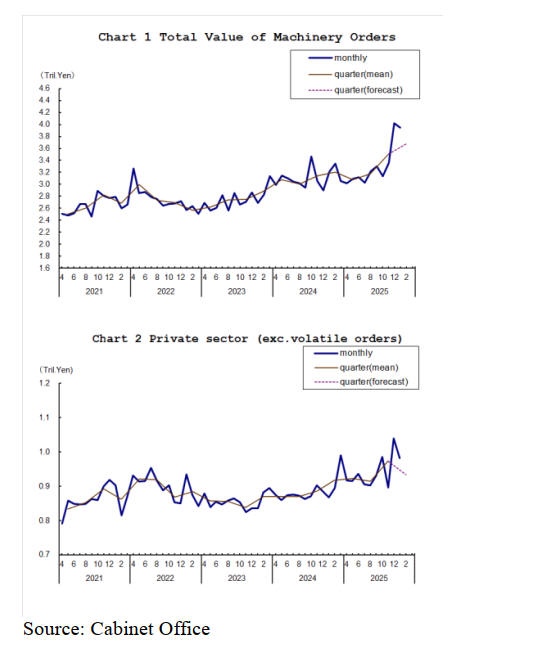
Japan's seasonally adjusted core machinery orders in
January fell 5.5% from the previous month, after a spike
driven by large-scale orders in December, according to
Cabinet Office data.
The private-sector orders, excluding those for ships and
equipment used at power companies, closely watched as a
leading indicator of corporate capital spending declined.
The Cabinet Office maintained its assessment, saying that
machinery orders are showing signs of picking up. Many
private think tanks expect corporate capital spending to
remain firm, but concerns remain over the conflict in Iran.
See: https://www.esri.cao.go.jp/en/stat/juchu/juchu-e.html
and
https://www.japantimes.co.jp/business/2026/03/19/economy/japa
n-machinery-orders-january/
Labour unions secure wage increases
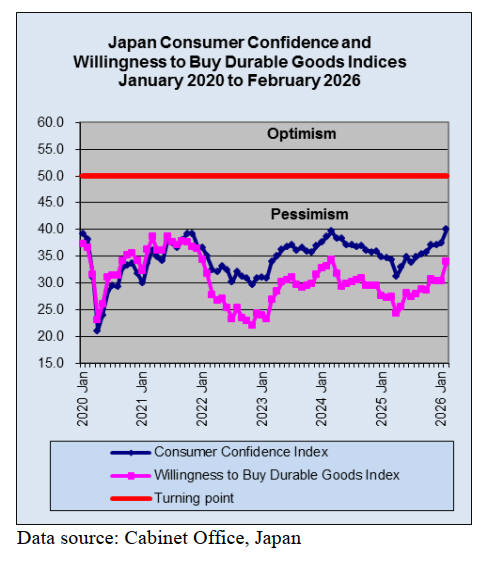
Domestic consumption is projected to be a primary driver
of Japan's economic growth in 2026 with real GDP
expected to grow by approximately 1.3% to 1.48%. This
growth is anticipated to be fueled by a cycle of wage
increases exceeding inflation, improving household
disposable income and government measures designed to
support consumption.
As of 23 March 2026, Japanese labour unions secured an
average annual wage increase of 5.26% in the preliminary
spring "Shunto" negotiations, a development that likely
will keep theBank of Japan on track for another interest
rate hike in the coming months.
This marks the third consecutive year of increases
exceeding 5% demanded to combat inflation and accepted
by the big companies as they face labour shortages. The
average 5.26% is slightly below 2025's 5.46%. Small and
mid-sized firms offered the unions 5.05%, missing the
union goal of 6% but still showing steady growth. These
figures will be revised several times as more companies
report results.
Sustained wage gains are needed to underpin consumption
and drive the demand-led price gains that the Bank of
Japan has been seeking as it pursues the conditions that
would allow it to normalise monetary policy.
Nobuyasu Atago, Chief Economist at Rakuten Securities
Economic Research Institute said “the results confirmed
the Bank of Japan’s baseline scenario that this year’s wage
negotiations have been solid”, adding “the key question is
how far the gains will spread to small and midsize firms”.
See:
https://www.japantimes.co.jp/business/2026/03/23/companies/re
ngo-labor-unions-wage-hikes/
Posibility ofcurrency intervention rises
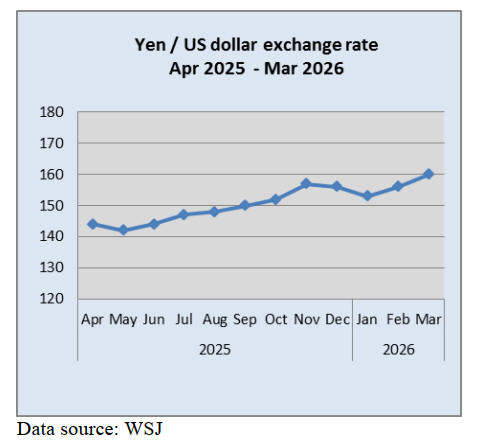
As the yen reached 160 to the US dollar level market
watchers are back on intervention watch. The US media
have said uncertainty has sparked safe-haven demand for
the US dollar. Now that 160 has been reached it is highly
likely the Japanese government will start yen buying.
Shortage of carpenters delaying home construction
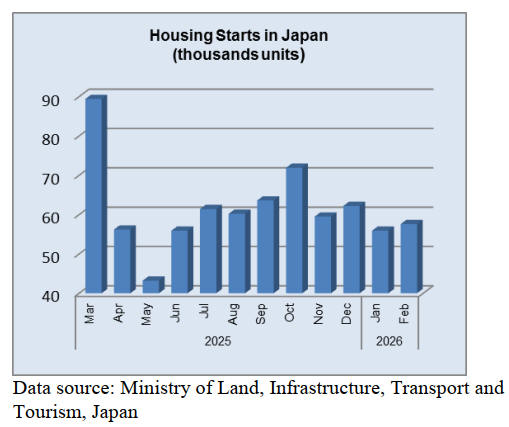
A severe shortage of carpenters in Japan has reached
critical levels causing significant delays in residential
construction, driving up home prices and disrupting the
housing market. It has been estimated that he number of
carpenters has dropped to one-third of the 1980 peak with
projections indicating further declines.
Homebuyers are facing delays of more than six months
before construction can begin due to the shortage of
experienced workers. Data indicates over 40% of current
carpenters are over 65 years old and less than 20% are
younger workers. The sub-contacting system for
carpenters leads to long hours and unattractive pay deters
younger people from entering the profession. New
regulations on overtime work, introduced to reduce long
hours have worsened labour availability.
See: https://www.asahi.com/ajw/articles/15709629
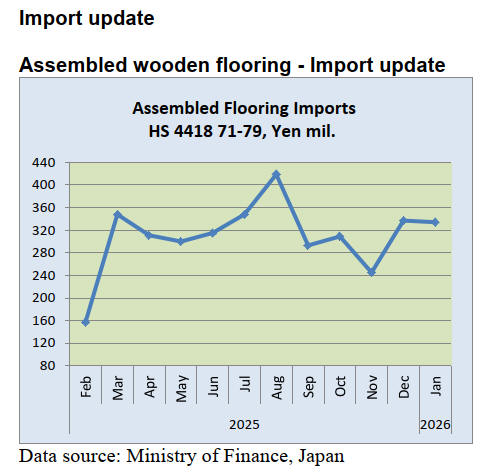
In December 2025 there was a reversal of the downward
trend seen in the previous three months and in January the
higher value of assembled wooden flooring (HS441871-
79) was maintained.
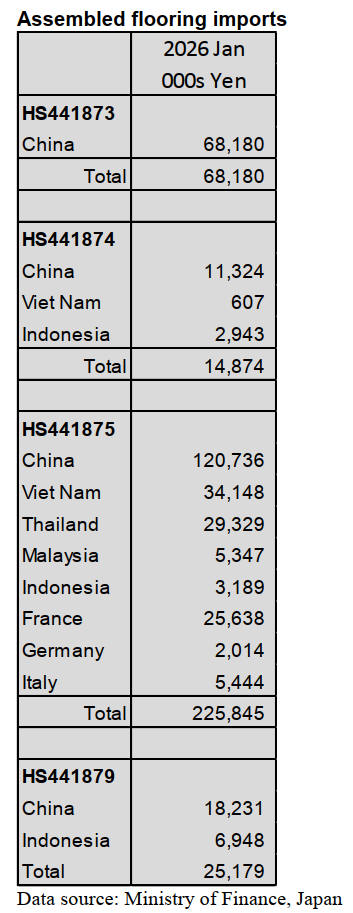
Year on year the value of January 2026 imports
declined
26% but compared to a month earlier the value of January
imports little unchanged.
Of the various categories of assembled flooring imports in
January, 90% was of HS 441875, a significant jump
compared to the previous three months. Of HS441875
imports four countries accounted for over 90% of arrivals
with 53% from China, 15% from Viet Nam, 13% from
Thailand and 12% from France. However shipments from
France were down sharply comped to December.
All imports of HS4418-73 originated in China and
accounted for 20% of January arrivals, up from the
previous month. For the other categories HS441879
accounted for 7% in January (10% in December) followed
by HS441874 at 4%.
Plywood imports
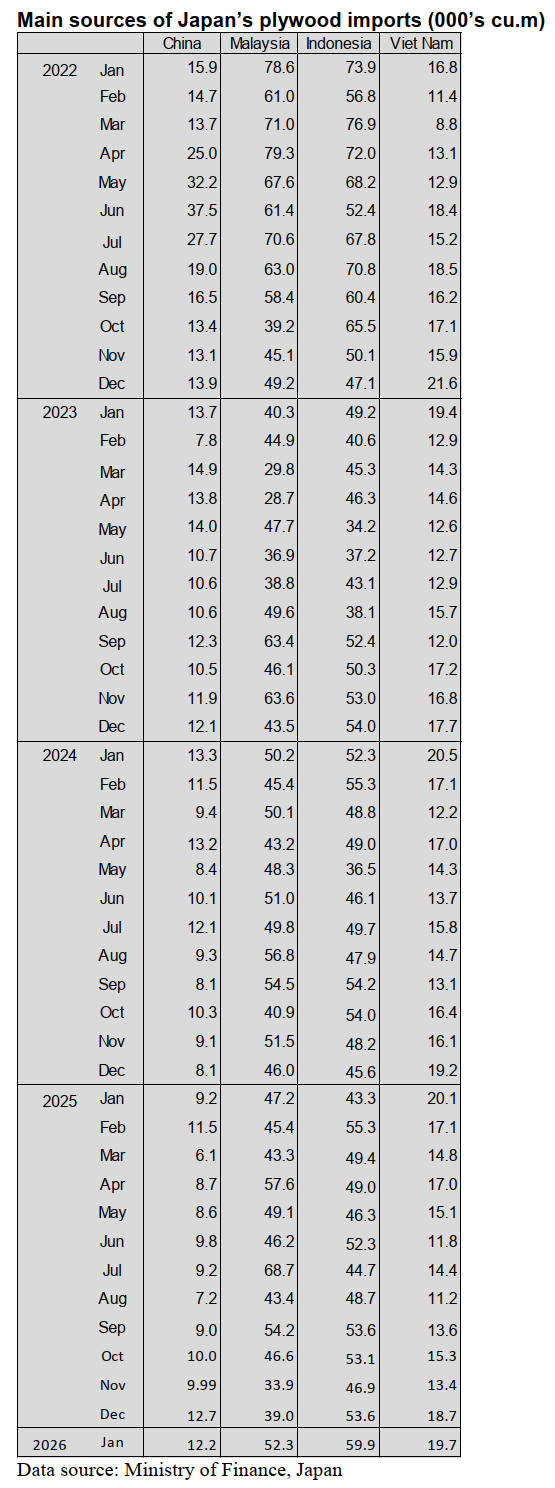
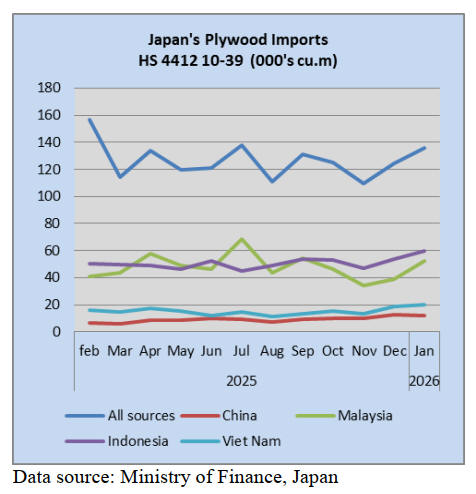
In January 2026 Indonesia and Malaysia continued as the
top suppliers of plywood to Japan with the combined
volume of shipments from the two main shippers
accounting for 83% of January imports (74% in
December).
January shipments from Malaysia were up sharply
compared to the volume shipped to Japan in December
2025 where as shipments from Indonesia were at around
the same level as in December. The other top shippers of
plywood to Japan in January were Viet Nam and China.
January arrivals from Vietnam were up from the previous
month whereas arrivals from China were at around the
same level as in December.
Arrivals from China in December 2025 and 2026, at
around 12,000 cu.m per month, were noticeably higher
than the monthly average in 2025.
In January 2026 arrivals of HS441210-39 were reported at
135,803 cu.m (124,460 cu.m in December). As in previous
months, of the various categories of plywood imported in
January 2026, HS441231 accounted for most (81%)
followed by HS441233 and HS441234 at a consistent 6%
each with the balance being HS441239 and HS441210.
Trade news from the Japan Lumber Reports (JLR)
The Japan Lumber Reports (JLR), a subscription trade
journal published every two weeks in English, is
generously allowing the ITTO Tropical Timber Market
Report to reproduce news on the Japanese market
precisely as it appears in the JLR. For the JLR report
please see: https://jfpj.jp/japan_lumber_reports/
Orders for house builders
The major homebuilders saw their order values in January
exceed those of the same month last year. However, this
was largely due to the weakness in orders a year earlier,
and it does not necessarily indicate an improvement in
demand conditions at the start of the year. With no rush of
last-minute demand expected this year—unlike in 2025,
when regulatory changes prompted early orders—
homebuilders are widely expected to face a challenging
environment in February and March.
The rental apartment segment performed well overall.
Amid expectations of rising interest rates, some consumers
are holding off on purchasing single-family homes and
instead shifting toward investment in rental properties.
The trend towards adding value and increasing the scale of
rental units has continued into the new year.
Wood products from NZ and Chile in 2025
In 2025, imports into Japan of New Zealand radiata pine
logs and Chilean radiata pine lumber both posted double-
digit declines, falling even further below the record-low
levels seen in 2024. The decline in imports has continued
for three consecutive years.
Although the yen’s depreciation eased last year, rising
ocean freight rates, port-handling charges, and warehouse
fees kept selling prices elevated, leading to a continued
shift in demand toward more affordable and readily
available Japanese cedar products. In the first half of the
year, international logistics delays and trade stagnation—
driven in part by the Trump tariffs—further dampened
industrial demand for wood-based packaging materials, as
demand for export crates and other industrial applications
weakened.
Imports of New Zealand radiata pine totaled 208,146
cbms, down 12.8% from the previous year, falling to less
than one-third of the recent peak of 723,000 cbms
recorded in 2012. Imports of Chilean radiata pine came to
142,125 cbms, a steep 16.5% drop from the previous year,
falling to less than half of the recent peak of 330,000 cbms
recorded in 2018.
Because about 90% of New Zealand radiata pine is
exported to China, prices for the Japanese market tend to
track Chinese market conditions. In mid-2025, prices for
China-bound shipments briefly fell to as low as US$105
per cbm on a C&F basis, one of the lowest levels seen in
the market. However, the weak yen kept import costs from
declining, accelerating the shift in demand toward more
affordable Japanese cedar.
Although Chilean lumber continued to arrive under the
same five-vessel framework as the previous year, major
producer CMPC shifted from joint bulk-vessel shipments
with Arauco to its own container-based transport. As a
result, Arauco was left to operate vessels on its own,
leading to an increase in mixed cargoes with pulp and
other products and pushing up ocean freight costs.
Consequently, upward pressure on the cost of Chilean
lumber has intensified.
Imported wood fuel in 2025
Japan’s imports of woody biomass fuels reached 15.739
million tonnes in 2025, including wood pellets and PKS,
marking a 26.9% increase from the previous year and
underscoring continued robust growth in demand.
Imports of wood pellets rose by just over 30% from the
previous year, while arrivals of PKS increased by slightly
under 20%. However, the gap between the two fuels
widened sharply, from 355,000 tonnes in 2024 to 1.535
million tonnes in 2025, as wood pellets saw a substantial
surge in demand, driven in part by their higher combustion
efficiency and other performance advantages.
The sharp increase in imports was driven in part by the
launch of several large-scale biomass power plants with
capacities exceeding 50,000 kW across Japan in 2025,
which significantly boosted demand for imported woody
fuels.
Imports of wood pellets totaled 8.637 million tonnes in
2025, representing a 35.4% increase from the previous
year. By country of origin, Vietnam remained the
dominant supplier with 5.682 million tonnes, up 71.4%
from the previous year.
It was followed by Canada with 1.292 million tonnes, a
10.8% increase, the United States with 676,000 tonnes, up
39.5%, Malaysia with 472,000 tonnes, up 17.1%, and
Indonesia with 404,000 tonnes, up 28.5%.
Imports of PKS came to 7.102 million tonnes, an increase
of 17.9% from the previous year.
By country of origin, imports totaled 5.515 million tonnes
from Indonesia, up 19.9% from the previous year; 1.479
million tonnes from Malaysia, a 7.1% increase; and
107,000 tonnes from Thailand, which surged 136.7% year
on year.
Although the latest FIT-certified installation data compiled
by the Agency for Natural Resources and Energy only
runs through June 2025, the number of operating facilities
in the general wood category had reached 113, up 12 from
the same month a year earlier. Total operating capacity
also increased to 9.91114 million kW, a year-on-year rise
of 662,690 kW.
Plywood
Shipments of domestically produced softwood structural
plywood remain sluggish across both traditional
distribution channels and precut factories, weighed down
by weak housing starts and buyer reluctance following
months of declining prices.
In February, several domestic manufacturers announced
price hikes for 12 mm, 3×6 plywood from March
shipments due to rising log and labor costs. This prompted
some buyers to advance purchases, though many remain
cautious, leaving market sentiment mixed.
Tokyo prices stand at ¥1,040–¥1,050 per sheet, with a firm
tone. Imported tropical plywood faces upward pressure
from Indonesian suppliers, especially for standard grades,
as natural-timber levies rise. Modest price increases have
been accepted after negotiations with Japan.
Malaysian producers, however, cannot raise prices due to
weak Japanese demand and currency-related cost
pressures. Indonesian export prices remain around
US$970/m³ for 2.4 mm, US$880/m³ for 3.7 mm, and
US$850/m³ for 5.2 mm. Indonesian export prices remain
around US$970/m³ for 2.4 mm, US$880/m³ for 3.7 mm,
and US$850/m³ for 5.2 mm, with 12 mm products
unchanged.
Domestic demand for imported plywood is subdued,
particularly for coated formwork plywood. Importers need
higher selling prices to cover costs but increases remain
limited. Current domestic prices range from ¥1,840–
¥1,900 for coated formwork plywood 12 mm to around
¥1,600 for formwork and structural plywood, and ¥780–
¥1,100 for Indonesian standard plywood depending on
thickness.
Domestic lumber and logs
Domestic cedar products are showing stronger price
momentum in the Kanto market as supply to precut plants
tightens. Although demand from major homebuilders has
eased since peaking in November–December 2025, orders
remain active, while local distribution channels continue
to stagnate.
With supply tightening since late last year, wholesalers
have raised prices, and standard KD cedar posts now trade
at ¥55,000–57,000 per cbm—about ¥2,000 higher than last
month—as mills in northern Kanto struggle to keep up.
Competing engineered wood products have also risen,
with laminated whitewood posts at ¥78,000–80,000 and
cedar laminated posts around ¥66,000, creating room for
further increases in solid cedar posts. Demand for cedar
studs is similarly strong, and limited supply of 45 mm
material has pushed prices above ¥65,000.
In contrast, the cypress log market remains weak outside
Okayama, where shortages have lifted prices. Cypress sill-
grade logs trade at about ¥23,000 per cbm in Okayama,
compared with ¥21,000 in Kyushu, ¥20,000 in Shikoku,
and ¥19,500 in northern Kanto—¥3,000–4,000 below last
autumn and ¥5,000–6,000 lower than a year earlier. The
decline reflects reduced demand amid sluggish product
markets rather than increased supply, as cedar log prices
remain firm.
While prices may rebound if demand recovers, a return to
last year’s unusually high levels appears unlikely. Cedar
medium-diameter logs remain stable at ¥16,000 in Akita
and northern Kanto and ¥14,000–14,500 in Kyushu.
Compared with a year earlier, prices are slightly lower in
Kanto and Kyushu but ¥2,000 higher in Akita, raising
attention as to whether a new price level is emerging.
Japan to revise formula for calculating wood self-
sufficiency rate
Japan’s Forestry Agency has proposed revising the
formula used to calculate the nation’s wood self-
sufficiency rate, aiming to provide a more accurate picture
of domestic supply. The proposal was presented at a
meeting of the Forestry Policy Council held at the
agency’s headquarters on February 20.
Under the current method, wood exports are included in
the denominator of the calculation, which can make the
self-sufficiency rate appear lower than the actual level of
domestic consumption. The agency now plans to exclude
export volumes from the denominator, effectively aligning
the metric with wood used within Japan. The revision is
intended to better reflect domestic supply-and-demand
conditions as the country seeks to expand the use of
domestically sourced timber.
The agency says the revision is necessary because Japan’s
heavy reliance on imported timber has exposed
vulnerabilities in the country’s wood supply. As these
risks become more apparent, accurately measuring the
contribution of domestically produced timber to national
consumption has grown increasingly important.
Under the current formula, exports are included in the
denominator on the grounds that it reflects the contribution
of domestically produced timber to Japan’s wood-related
industries. The agency also plans to revise the log-
conversion coefficients used to estimate the volume of
imported timber and other wood products.
|


