|
Report from
Europe
Another all-time low for UK tropical wood product imports
In 2025, the UK imported 377,900 tonnes of tropical wood
and wooden furniture products, 1.4% less than the
previous year. Although import value last year, at
US$1007.3 million, was 1.4% more than the previous year
in nominal terms, it was down 1% in real terms (taking
account of inflation).
In tonnage terms this was the lowest on record and, in
retrospect, may be seen as a continuation of a long-term
downward trend that started as far back as the 2008
financial crisis (Chart 1).
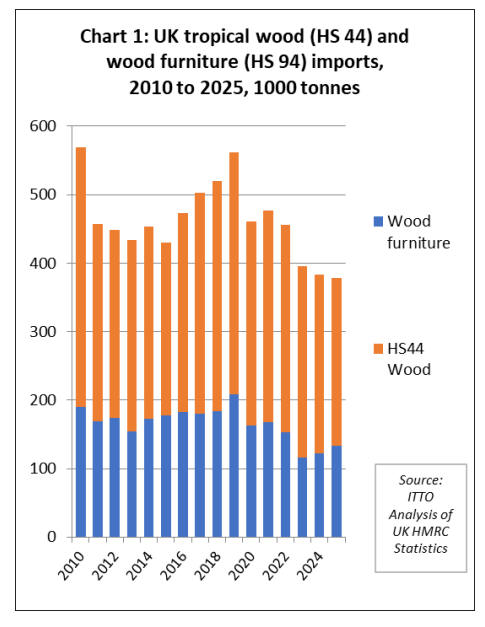
Import quantity last year was around half the level of
tropical wood imports into the UK typical two decades
ago. There was an upturn in UK tropical wood product
imports in 2015-2019, and another rebound in 2020-2022,
but these trends were driven respectively by a big increase
in imports of plywood faced with tropical hardwoods from
China, and then by the short-lived post-COVID boom.
While last year saw an increase in the quantity of UK
imports of wooden furniture from tropical countries(+9%
to 133,600 tonnes), mouldings/decking (+3% to 9,700
tonnes), flooring (+46% to 3,100 tonnes), and kitchenware
(+9% to 2,500 tonnes), there was a decline in imports of
tropical plywood (-8% to 87,100 tonnes), joinery products
(-3% to 72,100 tonnes), sawnwood (-6% to 55,500
tonnes), sleepers (-12% to 2,700 tonnes), and picture
frames (-19% to 2,300 tonnes).
UK imports of tropical wood and wooden furniture in the
fourth quarter of 2025 were 93,339 tonnes, 5% more than
the previous quarter, when imports of only 88,500 tonnes
were close to an historical low. UK tropical imports in Q4
2025 were down 8% compared to the same quarter the
previous year.
Tropical wood products underperformed in UK
The UK market for tropical wood and wooden furniture
last year was significantly slower than the wider UK
market for these products. UK import value of wood and
wooden furniture from all supply regions was US$11.35
billion in 2025, 4% more in real terms compared to the
previous year. The share of tropical wood and wooden
furniture products in total UK import value declined from
9.5% in 2024 to just 9.0% during 2025. This share is now
well down on the 11.4% share achieved in 2022 and close
to 14% share typical before the COVID pandemic.
Considering the value of UK imports of all wood and
wooden furniture products in 2025, imports from China
were, at US$2.70 billion, 5% more than in 2024. China’s
share of total UK import value was 23.8% in 2025,
marginally up from 23.7% in 2024. Wood and wooden
furniture imports from the EU increased their dominance
of the UK market last year, rising 6% to US$6.71 billion.
Imports from the EU accounted for 59.1% of all UK
import value of wood and wooden furniture in 2025, up
from 58.4% share in 2024.
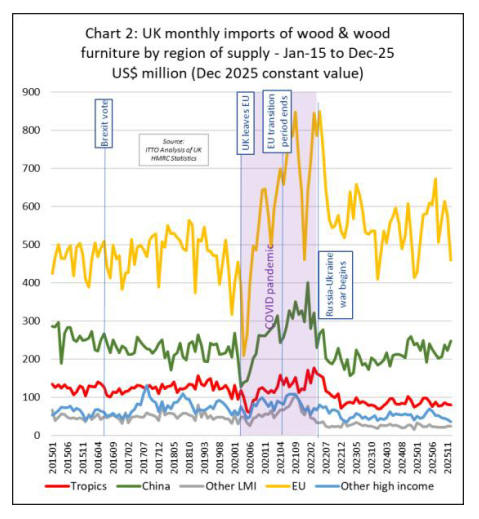
The most notable recent trend in the UK market for wood
and wooden furniture was a step change during the
COVID pandemic as the country became generally more
reliant on regional suppliers in Europe.
This trend ran contrary to expectations following the UK’s
departure from the EU in 2020 which led to speculation
that the country might turn more to alternative suppliers
outside Europe. UK imports from China recovered ground
in 2024 following a downturn in the immediate aftermath
of the pandemic, but this trend lost impetus in 2025 (Chart
2).
UK growth forecasts slashed on fears of interest rate increases
Prospects for any improvement in the UK market now
seem very slim. According to the Times of London, City
analysts are significantly reducing GDP estimates and
raising their forecasts for inflation. There is also little
room for the government to offer significant financial
support for households that will see their costs rise
because of the war in the Middle East.
Oxford Economics said that it now expected the UK
economy to expand by just 0.4 per cent this year, down
from its prior projection of 0.9 per cent. The research
consultancy also said that GDP would rise by 1 per cent
next year, down from its previous prediction of 1.3 per
cent.
“We expect a larger rise in inflation over the next year to
result in a more pronounced slowdown in activity growth,”
analysts wrote in a note to clients, adding that inflation
would peak at 4.1 per cent in the summer, more than
double the Bank of England’s 2 per cent target.
Deutsche Bank now believes that UK interest rates will
stay at 3.75 per cent for the rest of the year, having
previously predicted a handful of reductions.
However, the Times suggests other analysts are even more
pessimistic: “Markets now suggest that the Bank could lift
borrowing costs three times this year to 4.5 per cent from
3.75 per cent now, having just last month expected three
interest rate cuts”. This at a time when UK borrowing
costs are already at an 18 year high.
The latest data from the UK construction sector is
particularly troubling for UK wood demand. According to
the latest data from the UK Office of National Statistics,
total construction output in the UK is estimated to have
fallen by 2.0% in the three months to January 2026; this is
the fourth consecutive fall in the three-monthly series.
Over the three-month period, both new work, and repair
and maintenance, fell by 3.2% and 0.4%, respectively.
At the sector level, seven out of the nine sectors fell in the
three months to January 2026; the main negative
contributor to the decrease was private new housing,
which fell by 6.3%.
Monthly construction output is estimated to have grown
by 0.2% in January 2026; this follows three consecutive
falls in the monthly series. The increase in monthly output
in January 2026 came solely from an increase in repair and
maintenance, which grew by 3.3% as new work fell by
2.0%.
Sharp rise in wooden furniture from Vietnam
While the UK furniture market was far from buoyant, the
efforts of some tropical suppliers to diversify markets in
the UK in response to US tariff pressure are beginning to
pay off. In 2025, UK import value of wooden furniture
from tropical countries increased 11% in nominal terms to
US$506 million while import quantity increased 9% to
133,600 tonnes.
Wooden furniture imports from tropical countries
increased particularly sharply from Vietnam (+20% to
US$282.6 million), building on momentum that built up in
the second half of 2024.
Imports increased at a more moderate pace from Malaysia
(+3% to US$111.7 million), and Indonesia (+3% to
US$43.3 million). Imports from India were unchanged at
US$53.4 million.
However, imports declined from Thailand (-21% to
US$7.1 million), and Singapore (-20% to US$4.3 million).
UK wooden furniture imports were negligible from all
other tropical countries in 2025 (Chart 3).

Falling UK imports of joinery products
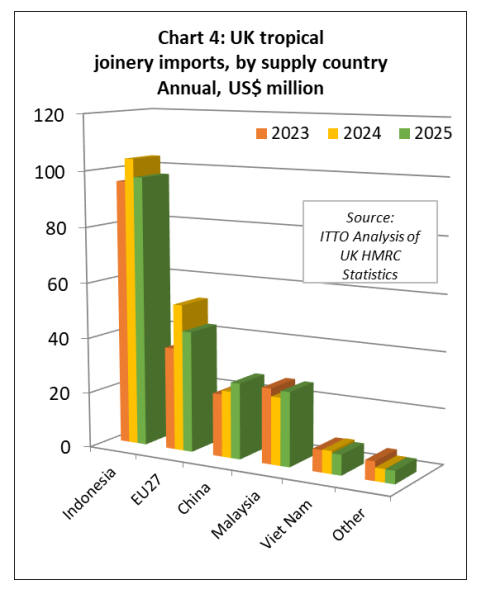
Total UK import value of tropical joinery products
decreased 5% to US$206.8 million in 2025 while import
quantity was down 3% to 71,100 tonnes. Following a big
increase in 2024, imports of these products from the EU
fell 18% to US$43.5 million last year. Imports from
Indonesia, mainly comprising doors, were US$97.3
million in 2025, 6% less than in the previous year.
Imports also fell from Vietnam in 2025, by 10% to US$7.3
million. These declines were partly offset by rising
imports of tropical hardwood joinery products from China
(+14% to US$27.3 million), and Malaysia (+10% to
US$26.7 million) (Chart 4).
UK imports of hardwood plywood
The UK imported 162,000 cu.m of hardwood plywood
from tropical countries in 2025, 9% less than in the
previous year. Import value fell by 11% to US$100.6
million. However, this was mainly due to a decline in
imports from China.
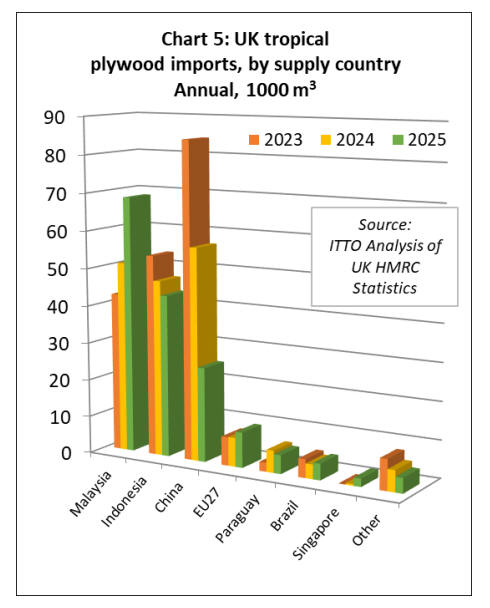
Direct UK imports of hardwood plywood from tropical
countries increased 12% to 126,900 cu.m in 2025. Imports
were up 35% to 68,600 cu.m from Malaysia and up 13%
to 4,400 cu.m from Brazil.
Imports also increased from zero to 2,200 cu.m from
Singapore. These gains offset declines of 8% to 43,300
cu.m from Indonesia and of 16% to 5,000 cu.m from
Paraguay.
The UK imported 25,200 cu.m of plywood with an outer
layer of tropical hardwood from China in 2025, 56% less
than in 2024. In contrast, UK imports of tropical
hardwood plywood from EU countries increased last year,
by 22% to 9,400 cu.m (Chart 5).
Congo and Malaysia increased share of UK tropical sawnwood
UK imports of tropical sawnwood were 82,400 cu.m in
2025, 7% less than the previous year. Import value was
down 4% to US$102.3 million. The most notable trends
last year were sharp rises in imports from the Republic of
Congo (+27% to 13,200 cu.m) and Malaysia (+31% to
11,700 cu.m).
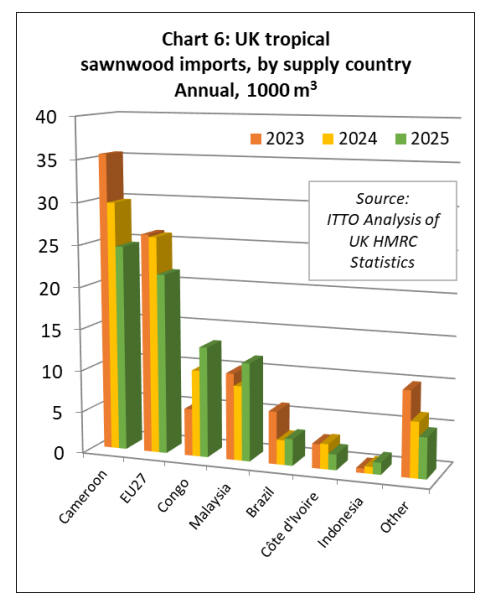
Large percentage gains were also made in imports from
Brazil (+8% to 3,200 cu.m) and Indonesia (+72% to 1,400
cu.m). These gains offset declining imports from
Cameroon (-17% to 24,600 cu.m) and Côte d'Ivoire (-37%
to 1,875 cu.m). Indirect imports from the EU also fell, by
17% to 21,500 cu.m. (Chart 6 above).
The introduction of the log export ban and shift towards
more kiln dried production by some leading exporters in
the Republic of Congo has been particularly critical to
expansion of the UK market which has no hardwood
processing capacity of its own.
This trend also partly explains the decline in UK imports
of tropical sawnwood from the EU in 2025 as more kiln
dried product is being imported direct from the Republic
of Congo instead of being shipped first to the EU for
drying.
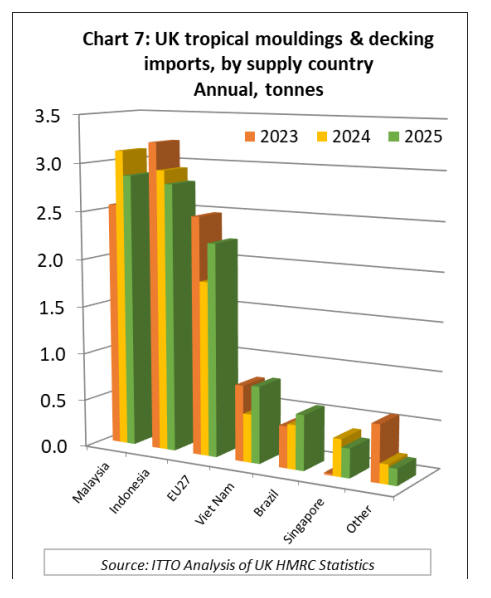
UK imports of tropical hardwood mouldings/decking
increased 3% to 9,700 tonnes in 2025. However, import
value fell 0.4% to US$26.4 million.
Import quantity declined from the two largest suppliers,
Malaysia (-8% to 2,900 tonnes) and Indonesia (-5% to
2,800 tonnes). However, imports increased from Vietnam
(+59% to 800 tonnes) and Brazil (+25% to 600 tonnes).
Imports of tropical mouldings/decking imports from the
EU also increased, by 22% to 2,200 tonnes (Chart 7).
|


