Japan
Wood Products Prices
Dollar Exchange Rates of 10th
August
2026
Japan Yen 159.30
Reports From Japan
Business sentiment improves at major manufacturers
The closely followed Tankan business survey in Japan
shows sentiment improved at major manufacturers for the
fifth straight quarter. This was despite analyst’s concerns
the Middle East conflict would dampen the mood.
The Bank of Japan quarterly Tankan survey says the
sentiment index for large manufacturers was plus 22, up 5
points from the previous survey. A positive number
indicates more companies are optimistic about business
conditions than pessimistic. The survey covered about
9,000 companies.
The upturn suggested that the economy has, for now,
remained resilient despite the energy shock triggered by
the Middle East conflict. Confidence strengthened across
firms producing wood products, up 7 points compared to
zero in the first quarter.
Looking ahead three month, the confidence at major
manufacturers declined 5 points and for large non-
manufacturers confidence fell 9 points.
In related news, only around half of major Japanese
companies expect the domestic economy to grow in the
year ahead, down from 70% six months ago reflecting
concerns over inflation from the prolonged conflict in the
Middle East according to a Kyodo News survey.
Some 51% expect gradual economic growth over the next
12 months, while 38% expect growth to be flat and 5%
expect the economy to contract moderately.
See: https://www3.nhk.or.jp/nhkworld/en/news/20260701_B3/
and
https://mainichi.jp/english/articles/20260809/p2g/00m/0bu/0090
00c
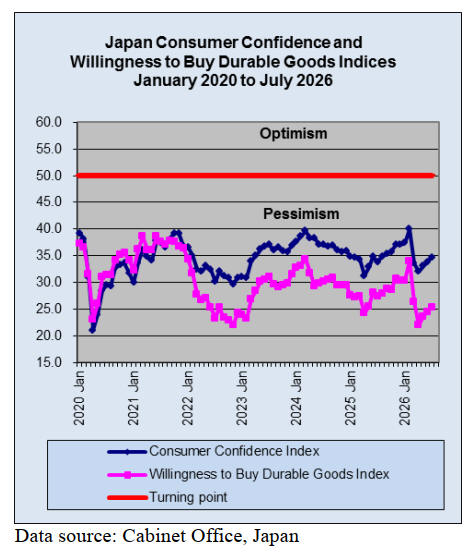
Household spending falls for seventh month
Japan’s household spending in July fell unexpectedly for a
seventh month even as real wages continued to rise,
reflecting the impact of persistent inflation on consumer
sentiment. Outlays by households adjusted for inflation
dropped 3.3% in June from a year earlier, according to the
Ministry of Internal Affairs.
The decline in overall spending was led by drops in
spending on food, utilities, transportation, communication
and apparel. Outlays for education rose along with
spending on home maintenance.
The fall in consumption clouds prospects for domestic
demand-led growth even as government subsidies have
capped utility costs and inflation-adjusted wages have
advanced every month this year on an annual basis.
According to Takeshi Minami, Chief Economist at the
Norinchukin Research Institute, “while consumption may
have stagnated slightly in June it remained resilient overall
for the second quarter and I forecast positive GDP
growth”, Minami said.
The government has deployed an array of subsidies to
soften the blow from inflation, including support to lower
utility fees and cap gasoline prices.
See:
https://www.japantimes.co.jp/business/2026/08/07/economy/japa
n-household-spending-cut-june/
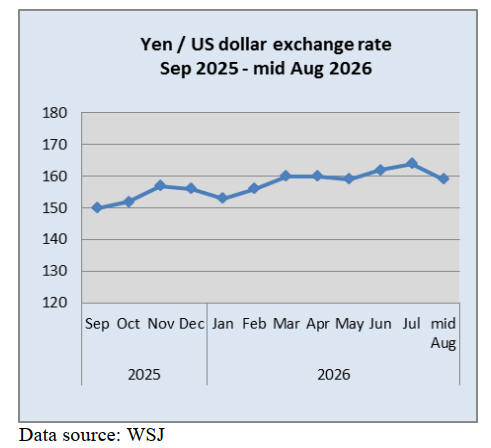
Joint interventionton support yen by Japan and US
In early August the yen strengthened significantly against
the dollar from yen162.80 to the yen157 mark to the dollar
in a matter of about an hour after a joint intervention by
Japan and the US. The move came after the yen broke
through ¥163 to the dollar, a four-decade low.
The timing also coincided with the conclusion of the US
Federal Reserve’s Federal Open Market Committee
meeting on Wednesday that decided to maintain its policy
rate. A US$73 billion intervention in late April after the
yen fell to yen160 to the dollar briefly lifted the currency
back to around ¥155 but those gains vanished within a
month.
Much the same appears to be happening with the latest
intervention as the yen is already showing signs of
weakness.
Yen-buying interventions have a limited impact because
they act as temporary fixes that fail to alter the
fundamental economic forces driving the currency down.
See:
https://www.japantimes.co.jp/business/2026/07/31/markets/yen-
intervention-breaking-2026/
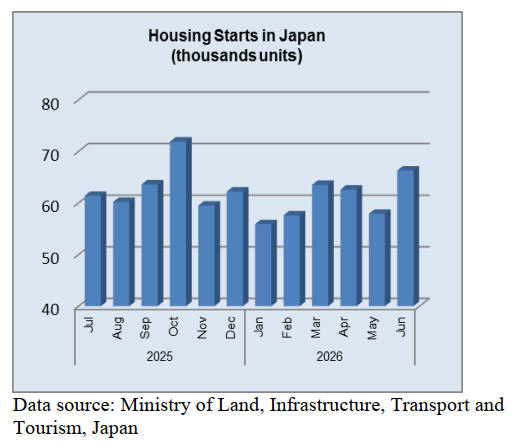
title
Japan's housing starts increased by around 19% year-on-
year in June 2026, reaching 66,344 units according to data
from the Ministry of Land, Infrastructure, Transport and
Tourism. This growth exceeded market expectations of
12.8%.
The construction sector in Japan regularly slows down
during the Obon (Bon) holiday in mid-August. Companies
close offices and job sites. Workers take time off to visit
their home towns. Material deliveries and outside work
pause for a short break. Workers take paid leave to join
family traditions to honor ancestors.
See: https://nippon.jac-skill.or.jp/en/life-in-japan/what-is-obon-
in-japan.php
 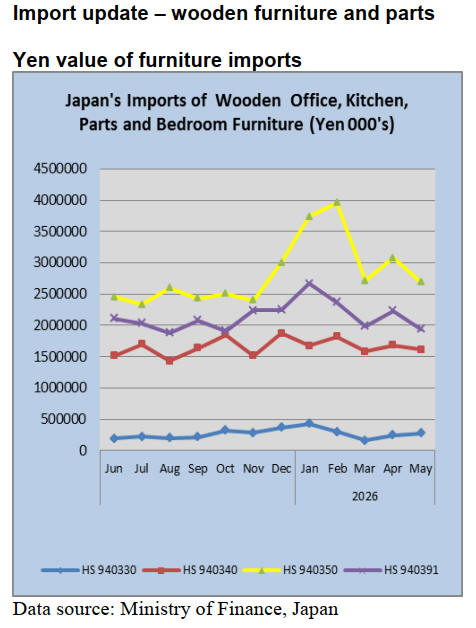
May 2026 wooden office furniture imports (HS940330)
The value of May imports from the top shipper, China was
up 39% compared to the value of April imports and
shippers in China accounted for over 90% of Japan’s May
imports of wooden office furniture. A further 5% of the
total value of imports was from Malaysia (3.5%, a fivefold
increase on April) and Viet Nam (1.5%). The other
significant source in May 2026 was Turkey.
Year on year, the value of wooden furniture imports in
May 2026 were at around the same level as in May 2025
but month on month a 14% increase was reported.

As employees return to traditional routines office vacancy
rates in Tokyo recently dropped below 2% for the first
time since the pandemic with overall demand and rental
values hitting multi-decade highs. Companies are actively
expanding or upgrading spaces which is sustaining
demand for office furniture.
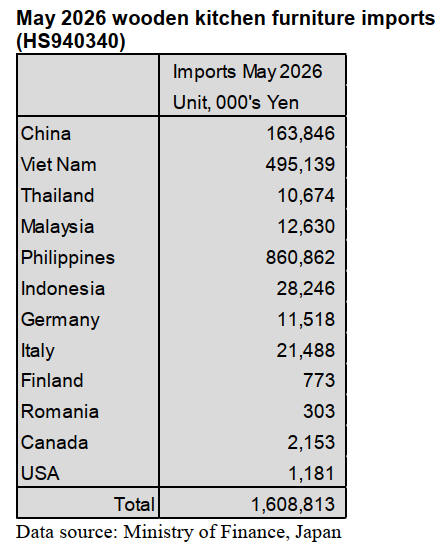
May 2026 wooden kitchen furniture imports
(HS940340)
Year on year the value of April wooden kitchen furniture
imports was up 10% while, compared to the value of April
imports, a 4% decline was recorded. The value of imports
from the top two sources, the Philippines and Viet Nam
were at around the same level as in April, however,
shipments from China were higher by about 24%.
In May, shipments from the Philippines accounted for
54% of total wooden kitchen furniture imports and a
further 39% was sourced in Viet Nam. China was the third
ranked source accounting for around 10% of May arrivals.
The other shippers of note in May were Indonesia and
Italy.
While new home construction is low due to a shrinking
population, Japan's renovation market is growing.
Homeowners are upgrading existing spaces rather than
buy new houses. Kitchens are a main focus because
lifestyles have changed and people spend more time at
home.
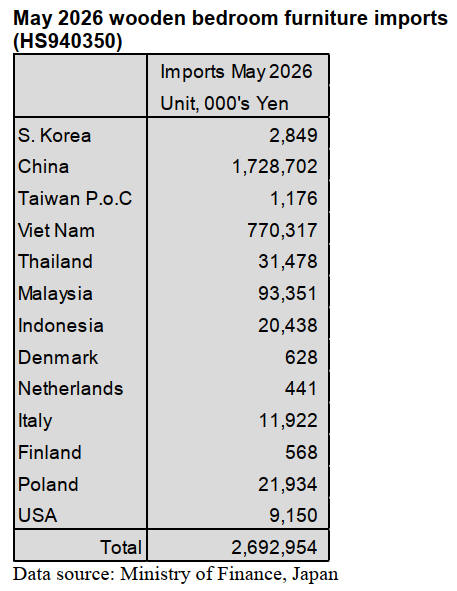
May 2026 wooden bedroom furniture imports
(HS940350)
The value of arrivals of wooden bedroom furniture in May
2026 were at around the same level as in May 2025 but
compared to the value of April imports a 14% decline was
reported.
Three countries accounted for 93% of the value of
HS940350 imports in May; China, 64% (60% in April),
Viet Nam 29% (32% in April) and Malaysia 3.5%.
The other significant supplier of wooden bedroom
furniture to Japan in May was Thailand.
The value of imports from China in May was down 7%
month on month, from Viet Nam, down 21% month on
month and from Malaysia down 29%.
Japan represents around 15% share within the Asia-Pacific
bedroom furniture market due to strong demand for
compact and multifunctional furniture products suitable
for smaller residential spaces. Japanese consumers
increasingly prefer minimalist furniture styles, modular
storage systems and premium wooden bedroom
collections designed for efficient space utilisation.
See: https://www.fortunebusinessinsights.com/bedroom-
furniture-market-116403
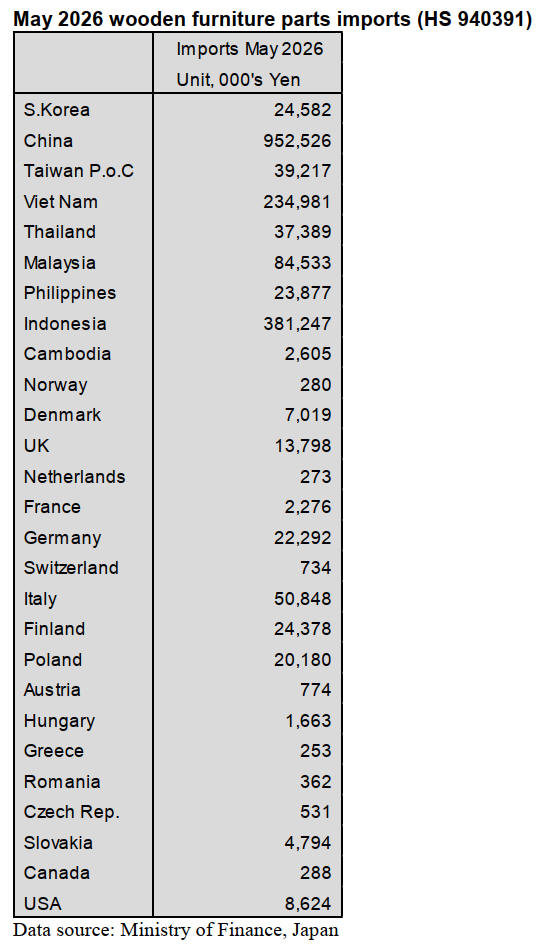
May 2026 wooden furniture parts imports (HS940391)
From the beginning of 2026 there has been a downward
trend in the value of imports of wooden furniture parts.
May 2026 imports were at around the same level as in
May 2025 but compared to April there was a 13% decline.
As in previous month’s shippers in China and three SE
Asian countries, Indonesia Viet Nam and Malaysia
accounted for 89% (84% in March) of Japan’s imports of
wooden furniture parts (HS940391) in May 2026.
The main shipper of wooden furniture parts to Japan in
April was China at 49% (54% in April) followed by
Indonesia at 20% (16% in April), Viet Nam 12% (14% in
April) and Malaysia 4% (6% in April). The value of
imports from China in May 2026 was down 12% month
on month, imports from Indonesia were unchanged from
April, imports from Viet Nam were down 23% and from
Malaysia down 22%.
Domestic factories face high labour expenses, an
aging
workforce and a shrinking labour pool. Local companies
offset these pressures by shifting labor-intensive parts
production overseas while finishing assembly at home.
Trade news from the Japan Lumber Reports (JLR)
The Japan Lumber Reports (JLR), a subscription trade
journal published every two weeks in English, is
generously allowing the ITTO Tropical Timber Market
Report to reproduce news on the Japanese market
precisely as it appears in the JLR. For the JLR report
please see: https://jfpj.jp/japan_lumber_reports/
Price hikes across all products from October
YKK AP will raise product prices from October due to
higher energy, logistics and material costs and the
prolonged yen depreciation. Housing products will
increase 10–15%, exterior items 10–20%, metal coatings
about 15% building-use products 10–15%.
South sea logs and lumber
Prices for tropical hardwood and China-made products
remain elevated as supply pressures persist. Log output at
origin has been slow to recover, limiting producers’
ability to meet Japan’s orders and pushing up prices for
deck materials and truck-body components.
Laminated free boards are also rising. Indonesian merkusii
pine continues to climb, with manufacturers holding firm
amid log shortages. Domestic distributors had continued
buying merkusii pine despite earlier increases, but with
prices still rising, more are shifting to China-made radiata
pine and red pine—though Chinese suppliers have also
begun raising prices. Tropical hardwood log prices
likewise remain high due to rising production costs.
Demand for domestic shipbuilding and steel-industry
supports is stable, but with the yen’s depreciation adding
pressure, it remains difficult to gauge when prices will
settle.
Strong demand pushes up prices for oak, birch and
sen
Sales at the Hokkaido hardwood specialty auction held by
the Asahikawa Lumber Industry Cooperative surged to
¥41 million in June, doubling the level of a year earlier
amid increased offerings, solid material quality and strong
buying ahead of the next auction in September. As the
final sale for the first half of the year, the auction saw
1,143 cbms offered and 1,140 cbms sold, with an unsold
rate of just 0.28%, underscoring exceptionally firm
demand.
Single-log lots accounted for 835 cbms at an average of
¥41,000 per cbm, while lot-grouped logs totaled 304
cbms— nearly 27% of all volume—at an average of
¥22,000. Prices for major species rose sharply, including
konara oak at ¥59,000 per cbm, mezhiro birch at ¥39,000
and sen at ¥37,000, while some species such as tamo,
makaba, nire and shina saw declines reflecting buyers’
quality assessments. Lot-grouped logs also strengthened,
averaging ¥22,000 per cbm, up ¥10,000 from a year
earlier, highlighting broad-based firmness across
categories.
Cesium levels in forests now stable
The Forestry and Forest Products Research Institute
(Tsukuba, Ibaraki Prefecture) reported that long-term
monitoring has clarified when the movement of
radioactive cesium-137 in forests stabilized following the
Fukushima Daiichi nuclear accident. Drawing on a decade
of continuous field data, the institute found that both the
distribution of cesium-137 within trees and its transfer
from soil reached a stable state roughly six years after the
accident. This provides a more reliable basis for
forecasting future cesium-137 concentrations in timber,
supporting decisions on resuming forestry operations and
using wood materials in affected regions.
After the 2011 accident, cesium-137 was widely deposited
across forested areas, creating an urgent need to
understand how much of the radionuclide would remain in
timber over time. Earlier prediction models produced
widely differing results, underscoring the difficulty of
estimating long-term cesium behavior. To address this, the
institute conducted continuous surveys from 2011 to 2020
in forests in Fukushima and Ibaraki prefectures, analyzing
changes in cesium-137 found in leaves, branches, bark
wood— including sapwood and heartwood—of species
such as Japanese cedar and Japanese oak.
The study confirmed that by around year six, cesium-137
distribution within trees had largely stopped shifting and
that transfer from soil no longer showed major variation.
The institute said these findings form an important
scientific foundation for determining when forestry
operations can safely resume and how timber from
affected areas can be utilised. It added that continued
monitoring across a wider range of forest types is expected
to further refine prediction models and improve
assessments of long-term environmental behavior of
radioactive materials.
This spring, marking 15 years since the Great East Japan
Earthquake, the government outlined initiatives for the
third phase of the Reconstruction and Revitalization
Period (fiscal 2026–2030). In the agriculture, forestry
fisheries sectors, the plan calls for advancing forest
maintenance measures— such as thinking to prevent the
outflow of soil containing radioactive materials, along
with radiation-related safety steps for on-site work.
The government also aims to restore satoyama woodlands
and revive production areas for high-quality logs and log-
grown shiitake mushrooms. In particular, it highlights
systematic restoration of broadleaf satoyama—traditional
mixed-use forests that support activities such as producing
logs for shiitake cultivation—as part of broader efforts to
revitalize the wood industry.
2025 forest and forestry White Paper
The government has approved the 2025 edition of the
Forest and Forestry White Paper at a Cabinet meeting.
At the beginning of this year’s White Paper, the
government highlights efforts to link timber use with
reforestation, emphasising in particular the importance of
appropriate price negotiations across the entire timber-
trading supply chain to ensure that reforestation can be
sustainably financed.
Meanwhile, the White Paper points to emerging
developments in the use of wood in buildings, noting that
ongoing discussions on institutionalizing life-cycle carbon
assessments for construction, along with revisions to the
SHK system, are expected to enable more quantitative
evaluation of the benefits of timber use and further
encourage its adoption. Japan’s SHK system, a domestic
framework for evaluating the carbon benefits of using
wood in buildings, is being revised to allow more
quantitative assessment aligned with life-cycle carbon
evaluation practices.
To promote reforestation, the White Paper also outlines
measures such as identifying suitable sites for forestry
operations and consolidating management among forestry
operators.
|


