|
1.
CENTRAL AND WEST AFRICA
Rising fuel and transport costs place further pressure
on sawmills
Operating costs for Gabon's timber industry are continuing
to rise, with the latest reports from forestry operators
indicating that commercial diesel prices have reached
approximately FCFA1,300 per litre, compared with
around FCFA1,200 reported at the end of October.
The increase is having a direct impact on timber
harvesting and long-distance transportation, particularly
for sawmills operating in the eastern and northern
production regions.
Industry contacts report that trucking costs for sawn
Okoumé from Makokou and Okondja to the Port of
Owendo have increased from approximately FCFA 1.6
million to almost FCFA2 million per truck, representing a
rise approaching 25%.
These higher transport charges come at a particularly
difficult time for producers with demand from China
remaining extremely weak. Sawmills are consequently
facing the choice of reducing production, accumulating
additional stocks or increasing their focus on alternative
hardwood species such as Ovangkol, Belli and Okan,
where market conditions remain comparatively more
stable.
Heavy rainfall is adding to the difficulties. Transport from
Makokou and Okondja to Owendo, a distance of
approximately 750 kilometres, is now reportedly taking
two to three days, compared with around two days
previously.
The deterioration in road conditions is particularly
problematic for timber transported from remote forest
concessions, where laterite roads become increasingly
difficult to use during sustained rainfall.
Separately, a new fuel pricing schedule circulated at the
beginning of November indicated a proposed industrial
diesel price of FCFA1,310 per litre. Several publications
reported that the revised prices had taken effect on 1
November. However, other local reporting, citing the
Ministry of Petroleum and Gas, stated that the schedule
had not yet received final government approval.
The reported price increase therefore requires clarification.
The higher costs being experienced by timber operators
are consistent with the wider pressure on industrial fuel
supplies and prices.
The government's financial position is an important factor
behind the proposed adjustments. Fuel subsidies
reportedly cost the Treasury approximately FCFA30
billion during September, compared with monthly
expenditure of FCFA7–9 billion before the recent
international energy crisis.
For the timber industry, any sustained increase in fuel
costs will add further pressure to export competitiveness at
a time when overseas buyers remain reluctant to accept
higher prices.
See: https://agpgabon.ga/gabon-carburants-les-prix-de-lessence-
et-du-gasoil-en-hausse-depuis-le-1er-novembre/
and
https://www.gabonreview.com/prix-des-carburants-la-hausse-
senflamme-dans-la-presse-pas-a-la-pompe/
Gabon
Owendo Port faces further disruption as dredging
problems intensify
Conditions at the Port of Owendo have deteriorated
further, with the latest industry reports indicating that
mechanical problems affecting dredging equipment are
beginning to restrict vessel access to parts of the port.
According to local shipping contacts, a dredger is
currently out of operation, leaving sections of the harbour
vulnerable to reduced navigational depth.
The latest field information suggests that some berths may
be restricted to vessels with a draught of approximately
4.5 metres, although this specific limitation has not been
independently confirmed by the port authority.
Shipping delays are consequently becoming a growing
concern. Vessels are reportedly waiting days before
berthing, while manganese shipments are also competing
with commercial cargo for available port facilities.
The situation is particularly significant for timber
exporters, who depend on reliable vessel schedules to
move containerised sawn timber and other processed
products to overseas destinations.
The wider issue of dredging responsibilities had already
attracted government attention. The Ministry of Transport
previously brought together the principal port stakeholders
to clarify the management of dredging and bathymetric
operations at Owendo.
Under the arrangements announced by the Ministry, the
Gabonese company NTAM was designated to undertake
dredging operations, while the port authority OPRAG
would develop technical cooperation with Tanger Med on
seabed monitoring.
The current reported equipment failure underlines the
importance of maintaining navigational depth and
ensuring adequate dredging capacity.
Further disruption is possible later in November. Industry
contacts report that a French military helicopter carrier is
expected to visit from 17 to 20 November, followed by a
Spanish naval vessel. If these visits proceed as indicated,
temporary restrictions on commercial berthing capacity
may result, although the schedules and operational
implications remain unconfirmed.
For timber exporters, extended vessel waiting times could
increase storage charges, disrupt contracted shipments and
raise the overall cost of supplying international customers.
See: https://transports.gouv.ga/le-ministre-detat-reunit-les-
acteurs-portuaires-pour-renforcer-la-coordination-des-operations-
de-dragage-et-de-bathymetrie-dans-la-zone-portuaire-dowendo/
Gabon signs major agreement for the sale of forest
carbon credits
A significant development in Gabon's forest economy
emerged on 3 November, when the government
announced agreements to sell approximately six million
tonnes of forest carbon credits to SEFE, the German state-
owned energy company.
The agreements were concluded through the Gabonese
Agency for the Development of the Green Economy
(AGADEV) and represent an important step towards
generating additional revenue from the country's forest
conservation activities.
The credits are described as jurisdictional carbon credits
certified under the ART-TREES standard and eligible for
use under CORSIA, the international aviation sector's
carbon-offsetting framework.
Unlike carbon credits developed through individual
forestry projects, jurisdictional credits relate to emissions
reductions and forest conservation activities assessed
across a wider geographical area. The first deliveries are
expected by the first quarter of 2027.
Local market discussions have referred to potential carbon
prices of approximately US$19 per tonne. However,
neither the government nor SEFE has publicly disclosed
the agreed transaction price and this figure should
therefore be regarded as an indicative market reference
rather than the confirmed value of the agreement.
The government has indicated that proceeds from the
transaction will be held under a designated financial
arrangement pending the introduction of a national
regulatory framework. This framework is also expected to
establish how benefits will be shared with local
communities.
The development is potentially significant for Gabon's
wider forestry sector, as it creates an additional financial
mechanism associated with maintaining forest cover and
improving sustainable forest management.
However, the relationship between carbon-credit revenues,
existing forestry concessions and commercial timber
operations will require further clarification.
For timber producers, the central question is whether the
development of Gabon's carbon market will create
additional opportunities for sustainable forest management
or introduce new obligations affecting existing concession
arrangements.
The agreements nevertheless represent an important shift
from earlier proposals towards an actual commercial
transaction involving forest carbon credits.
See: https://www.reuters.com/sustainability/climate-
energy/gabon-agrees-sell-about-6-million-forest-carbon-credits-
2026-11-04/
and
https://www.union.sonapresse.com/index.php/fr/credits-
carbone-souverains-le-gabon-signe-un-accord-historique-
avec-sefe
China–Gabon cooperation advances following
presidential visit
A new development affecting Gabon's wider industrial and
infrastructure ambitions emerged following President
Brice Clotaire Oligui Nguema's state visit to China
between 3 and 7 November.
During meetings in Shanghai and Beijing, Gabon sought
to strengthen Chinese participation in major industrial,
transport, energy and mining projects.
Several agreements and memoranda of understanding
were signed, covering industrial development, mining,
training and infrastructure. Of particular relevance to the
forestry sector are the discussions concerning improved
railway connections and the proposed development of the
Kobe-Kobe port.
However, the projects remain subject to financing,
technical studies and future implementation and there is no
indication that they will provide immediate relief for
timber operators.
The two countries also agreed to progress an economic
partnership agreement governing preferential customs
treatment for Gabonese products entering China.
See: https://presidence.ga/2026/11/08/retour-de-chine-ce-que-le-
gabon-rapporte-de-la-visite-detat/
and
https://presidence.ga/2026/11/05/gabon-chine-plusieurs-accords-
signes-a-shangai-pour-accelerer-la-modernisation-et-
lindustrialisation-du-gabon/
Gabon strengthens its position in African industrial
development
Gabon has emerged as one of Central Africa's leading
industrial economies, according to the African
Development Bank's Africa Industrialisation Index 2025,
which assesses industrial development across 54 African
countries between 2010 and 2024.
The country has risen from 23rd position in 2010 to 12th
in 2024, an improvement of 11 places, placing it ahead of
its regional neighbours, including Cameroon, Equatorial
Guinea and the Republic of the Congo.
This progress reflects improvements in Gabon's industrial
performance and its longstanding strategy of encouraging
greater domestic processing of natural resources, including
timber and minerals.
The development of timber-processing activities within
the Nkok Special Economic Zone has been an important
part of this industrial strategy, encouraging investment in
sawmilling, veneer and plywood production rather than
the export of unprocessed logs.
The findings therefore highlight an important distinction
between Gabon's longer-term progress towards
industrialisation and the immediate challenges affecting
the competitiveness and profitability of its timber industry.
See: https://www.afdb.org/en/documents/africa-industrialisation-
index-2025
and
https://gabonmediatime.com/rapport-bad-onudi-le-gabon-1er-
pays-le-plus-industrialise-en-afrique-centrale/
Market outlook
The operating environment for Gabon's tropical timber
industry has become increasingly difficult during the first
part of November.
Higher reported diesel and trucking costs are adding
directly to the expense of moving timber from forest
concessions and sawmills to Owendo, while the
continuing rainy season is restricting transportation along
laterite roads.
At the same time, the latest reports of dredging problems
at Owendo raise concerns about additional shipping delays
and the reliability of export logistics.
Chinese demand for Okoumé remains extremely weak,
leaving sawmills with limited opportunities to recover
their higher production and transport costs through
increased sales.
Some operators are responding by reducing production,
holding additional stocks or concentrating on hardwood
species for which international demand remains
comparatively more stable.
The difficulties reported with Padouk shipments to Europe
also highlight the combined financial and administrative
risks associated with weak buyer liquidity and CITES
documentation.
Against these immediate challenges, Gabon's agreement to
commercialise forest carbon credits represents an
important development in the country's forest economy.
The renewed cooperation with China may also support
infrastructure improvements and industrial investment
over the longer term.
However, neither development is likely to resolve the
immediate commercial pressures facing timber
producers.Overall, Gabon's timber sector continues to face
weakening export competitiveness, with higher operating
costs and increasing logistical disruption adding to
subdued international demand.
While new opportunities are emerging through carbon
markets and international investment agreements,
sawmills remain focused on controlling costs, protecting
cash flow and securing viable export orders.
Cameroon
Kribi Port – Additional timber facilities reportedly
completed
An important development has emerged at the Port of
Kribi, where industry contacts report that the planned
extension of timber-handling facilities has now been
completed.
At the end of October, the project was described as
approaching completion. The latest information indicates
that the additional log storage and sawn timber facilities
are now in place, reportedly under Chinese management.
If confirmed, this represents an improvement in
Cameroon's timber-export infrastructure and could provide
an additional outlet for operators seeking to reduce their
dependence on the increasingly congested Port of Douala.
The development is particularly relevant for timber
producers in southern Cameroon and northern Congo,
where Kribi is becoming an important export gateway for
containerised sawn timber.
The reported completion of the dedicated timber facilities
should therefore be distinguished from the larger
container-terminal expansion, which remains under
construction. For timber exporters, improvements to
Kribi's handling capacity could eventually provide greater
flexibility in selecting export routes, particularly as
shipping delays and road transport costs continue to
influence the competitiveness of Central African timber.
See: https://www.investiraucameroun.com/infrastructures/0810-
23934-port-de-kribi-21-5-milliards-de-fcfa-pour-accroitre-de-30-
les-capacites-du-terminal-a-conteneurs
Douala Port – Dredging operations resume
A further operational development concerns the Port of
Douala, where the latest industry information indicates
that dredging activity has resumed.
Maintaining sufficient depth in the Wouri River navigation
channel is essential for vessels using Douala, particularly
given the continuing accumulation of sediment and the
limited draught available along parts of the approach.
The resumption of dredging is therefore a potentially
positive development for timber exporters, who have been
facing extended vessel waiting times and difficulties
associated with port congestion.
Cameroon's port authorities have progressively
strengthened their own dredging capabilities through the
Régie Déléguée du Dragage, established to undertake
maintenance of the Wouri navigation channel.
The benefit for timber exporters will therefore depend on
whether continued dredging can improve navigational
conditions and facilitate more reliable vessel movements.
Any sustained improvement would be particularly
important for sawnwood and log shipments that continue
to depend heavily on Douala.
See: https://www.minmidt.cm/en/minim-martap-bauxite-project-
steady-progress-recorded-across-project-sites/
and
https://www.newsducamer.com/port-douala-controle-chenal-
wouri/
Log and sawn timber inventories decline at Douala
The latest information from the Port of Douala indicates
that timber inventories have declined since the end of
October. Fresh log stocks are now estimated at
approximately 1,500 cubic metres, compared with around
2,000 cubic metres previously.
These stocks include timber arriving from Cameroon,
northern Congo and the Central African Republic with
deliveries continuing to be affected by rainfall and
transport restrictions.
Sawn timber inventories have also fallen, with total stocks
across all species reportedly declining from approximately
3,000 cubic metres to 2,000 cubic metres. The reduction in
port inventories represents a change in the immediate
supply position.
However, it does not necessarily indicate stronger
international demand. The decline may reflect a
combination of reduced deliveries from forest concessions,
slowing export demand and cautious stock management by
producers.
The continued shipment of Azobé to Belgium and the
Netherlands is providing some business but the overall
market remains characterised by limited order visibility.
The decline in timber inventories will therefore require
monitoring. If forest deliveries remain restricted, stocks
could tighten further even without a significant recovery in
international demand.
Kribi Port launches further technical assessment of
vessel operations
A new development in the management of Kribi's
expanding port infrastructure was announced on 6
November. The Port Authority of Kribi launched a public
tender for a technical study examining the dynamic
mooring conditions of vessels using the port's second-
phase facilities.
The study will assess the effects of wind, currents, wave
movements and other maritime conditions on vessels
berthed at the terminal.
It will also examine potential operational interruptions and
identify measures to improve vessel safety and stability
alongside the quay.
Although the study does not specifically concern timber
exports, its findings could be relevant to the reliability of
container-shipping operations at Kribi.
As more timber exporters consider the port as an
alternative to Douala, the ability to accommodate vessels
safely and maintain predictable schedules will become
increasingly important. The study represents a further step
in the technical development of Kribi's port facilities
rather than evidence of an immediate operational problem.
See:
https://armp.cm/details?id_publication=65688&type_publication
=AO
Market outlook
Cameroon's timber market remains subdued during the
first part of November, although several developments
suggest potential improvements in export logistics over the
longer term.
Demand from major overseas markets has shown little
improvement, leaving sawmills cautious about expanding
output beyond confirmed orders.
Meanwhile, new technical work at Kribi and the
development of updated timber legality and certification
standards indicate that attention is increasingly being
directed towards strengthening export infrastructure and
preparing for international regulatory requirements.
Overall, Cameroon's timber industry continues to face
subdued market demand and seasonal supply constraints
but recent developments at Kribi and Douala offer the
prospect of improved export logistics. The immediate
challenge remains maintaining reliable timber supplies and
shipments while adjusting to increasingly demanding
international market requirements.
Republic of the Congo
New carbon-credit methodology introduced for
northern Congo forest concessions
A development affecting the commercial forestry sector
was announced on 4 November 2026 when the
international carbon standards organisation, Verra released
a new methodology module specifically covering natural
forest concessions in northern Congo.
The new module, VMD0063, forms part of Verra's
VM0035 methodology for improved forest management
through reduced-impact logging.
The framework is designed to allow eligible forestry
companies to generate carbon credits when they
demonstrate that improved harvesting practices reduce
damage to standing trees and surrounding forest areas
beyond established regional practices. Unlike carbon
programmes based entirely on avoiding forest clearance,
the methodology recognises that commercial timber
extraction can continue while operators implement
measures to reduce the environmental impact of
harvesting.
The new Congo-specific module establishes regional
baseline information that can be used to assess reductions
in greenhouse gas emissions resulting from improved
logging practices. It was developed by The Nature
Conservancy using information gathered from forestry
concessions in the Republic of the Congo.
This represents an important development because the
methodology provides a more direct potential link between
commercial forest management and carbon-credit
generation.
For Congo's forestry industry, the development is
particularly relevant given the difficult international
timber market and the government's continuing interest in
alternative sources of revenue from its forest resources.
If commercially viable projects emerge, carbon-credit
income could provide an additional incentive for forestry
companies to invest in reduced-impact harvesting,
improved forest management and environmental
monitoring.
See: https://verra.org/program-notice/verra-releases-new-
module-for-reduced-impact-logging-in-the-republic-of-the-
congo/
Government sets out climate investment programme
A further development in Congo's environmental
financing strategy was published by the Ministry of the
Environment, Congo Basin and Sustainable Development
on 2 November.
The government outlined an implementation and
investment plan associated with its updated national
climate commitments, known as CDN 3.0. The
programme includes measures intended to improve forest
conservation, strengthen environmental management and
mobilise new sources of climate-related financing.
For Congo's forestry sector, the programme provides
further evidence of the government's intention to place
greater economic value on forest conservation and
sustainable resource management.
This is becoming increasingly relevant as international
carbon markets develop mechanisms through which forest
owners and concession operators may be able to receive
income for verified environmental benefits.
The combination of national climate financing plans and
new carbon-credit methodologies could create additional
investment opportunities for companies able to
demonstrate responsible forest management.
See: https://developpement-durable.gouv.cg/2026/11/02/cdn-3-0-
du-congo-un-plan-dinvestissement-de-8883-milliards-usd-pour-
passer-de-lambition-a-laction/
Congo and FAO launch new forestry and reforestation
initiative
The government has also announced a new technical
cooperation programme with the Food and Agriculture
Organization of the United Nations (FAO), aimed at
expanding reforestation activities and developing
employment opportunities within the forestry sector.
The agreement was signed in Brazzaville on 29 October
and subsequently announced by the Ministry of Forest
Economy on 3 November.
The two-year programme, valued at approximately
US$246,000, will support the implementation of the
government's Pro-Jeunes initiative for afforestation and
reforestation.
Although modest in financial terms, the initiative is
intended to form part of a broader programme supporting
forest restoration and employment.
The government has called for international organisations,
financial institutions and private companies to participate
in developing practical programmes and mobilising
investment for forest restoration.
For the timber industry, the initiative may eventually
contribute to greater availability of forestry skills and
encourage investment in sustainable plantations and
forest-management activities.
See: https://economie-
forestiere.gouv.cg/actualite?cHash=6102e9b00e655f16044362e4
25f9dece&tx_news_pi1%5Baction%5D=detail&tx_news_pi1%5
Bcontroller%5D=News&tx_news_pi1%5Bnews%5D=751
and
https://www.aci.cg/monde-forets-ls-etats-membres-de-lonu-
appeles-a-sapproprier-la-decennie-du-boisement-et-du-
reboisement/
Market outlook
The immediate commercial outlook for Congo's timber
industry remains difficult, with no significant recovery in
international purchasing reported during the first part of
November.
Harvesting activity remains below earlier operating levels,
while producers continue to balance limited export
demand against the cost of maintaining forest operations
and sawmill production.
Established international timber traders continue to
provide some support for Asian business, particularly
where producers can supply the species and dimensions
required by existing customers. However, the continuation
of individual purchasing relationships is insufficient to
suggest a wider recovery in timber demand.
Against this challenging commercial environment, recent
developments in carbon financing could become
increasingly important for Congo's forestry industry.
Overall, Congo's timber industry remains under
commercial pressure with producers continuing to limit
output and concentrate on established export orders.
However, the development of carbon-credit mechanisms
for managed forestry concessions represents an important
longer-term opportunity.
2.
GHANA
Government commits to degraded forest recovery
The Minister for Finance and Economic Planning, Dr.
Cassiel Ato Forson, presented the 2027 Budget Statement
to Parliament on 12 November 2026 and announced a
GH¢400 million allocation for land reclamation,
environmental protection and the recruitment and support
of Blue Water Guards to intensify surveillance along
rivers and forest reserves.
He said the Government is committing GH¢30 billion,
representing 1.5% of Gross Domestic Product (GDP) to its
proposed New Economy Programme in 2027 to transform
Ghana’s economic structure, expand businesses and create
jobs. This forms part of a flagship US$10 billion multi-
year investment framework running from 2027 to 2030
aimed at job creation, local raw material processing and
economic transformation.
The budget centered around eight key pillars:
macroeconomic stability and affordable finance;
commercial agriculture and food security; energy
infrastructure to support a 24-hour economy; critical
minerals value addition; tourism, culture and creative arts;
textiles and garments; pharmaceuticals and manufacturing
including biomanufacturing and the technology economy.
https://www.graphic.com.gh/news/general-news/ghc400million-
to-be-allocated-for-reclamation-of-galamsey-destroyed-lands-in-
2027-budget-president-mahama.html
In related news, the state-owned Minerals Income
Investment Fund (MIIF), in partnership with the Forestry
Commission, has launched a five-year reforestation
programme to rehabilitate 50 hectares of degraded forest
in the Subri River Forest Reserve in the Western Region.
The initiative aims to advance environmental
sustainability and ensure that the country’s mineral wealth
is responsibly managed. Under the arrangement, the
Forestry Commission will provide technical expertise and
implementation support for the restoration.
The Chief Executive Officer of MIIF, Mrs. Justina Nelson,
explained that the project seeks to restore degraded forest
landscapes in mining areas, conserve biodiversity, enhance
climate resilience and promote responsible natural
resource management.
The Executive Director of the Forestry Commission, Dr.
Sarfo Adu, commended MIIF and its industry partners for
supporting the restoration effort while the representative of
the Ministry of Lands and Natural Resources, Macdana
Yunus, described the initiative as vital to safeguarding the
environment, protecting water bodies and preserving
natural resources for future generations.
See: https://www.graphic.com.gh/news/general-news/ghana-
news-miif-commissions-5-year-project-to-restore-50-hectares-of-
degraded-forest.html
Asian imports slide but is still Ghana’s top trade
destination
According to data from the Timber Industry Development
Division (TIDD) of the Forestry Commission, wood
product exports for the first eight months up to August
2026 generated a revenue of Eur57.68 million from an
export volume of 132,589 cu.m. Compared to the same
period in 2025 these figures represented decreases of 13%
in value and 8% in volume.
Exports to Ghana’s top trade destination, Asia, dropped
from 95,075 cu.m in 2025 to 73,535 cu.m in 2026, for the
same period. These figures accounted for 66% and 55% of
the total export volume for 2025 and 2026 respectively
whilst five (5) other markets accounted for the balance.
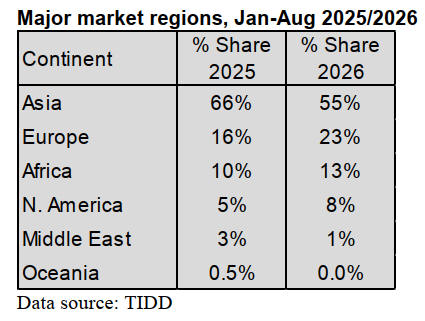
The European, African and Middle Eastern markets
registered appreciable increases in their 2026 wood
product volumes against the previous year from 16% to
23%, 10% to 13% and 5% to 8% respectively.
Air-dried sawnwood, billets, sliced veneer, kiln-dried
sawnwood and mouldings contributed to 73% of the 2026
total wood export volume compared to 88% recorded in
2025 same period. The lower export volumes of these
products resulted in a 16% year-on-year contraction in
wood product exports to Asian markets.
Billet exports recorded a notable decline, falling from
12,596cu.m in 2025 to 7,672cu.m, a 39% year-on-year
drop, ranking among the steepest declines. Teak (6,979
cu.m) and gmelina (693 cu.m) were the leading species,
exported. Revenue generated from these species amounted
to Eur1.80 million for teak and Eur0.09 million for
gmelina.
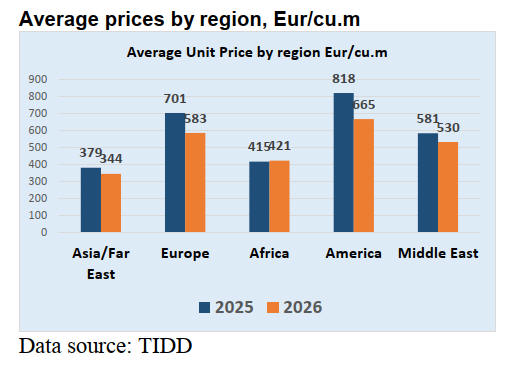
During the period under review, average unit prices
declined across most of Ghana’s export destinations of
Asia (-9%), Europe (-17%), America (-19%) and the
Middle East (-9%) with Africa (+1.4%) being the only
market to record an increase.
CSOs trained to strengthen timber legality audits
Representatives from fifteen Civil Society Organisations
(CSOs) have been provided with training to independently
monitor timber legality audits and strengthen
accountability in Ghana’s forestry sector under a 1.4
million Pounds regional forest governance project.
A five-day workshop, organised by the Forestry
Commission with EcoCare Ghana, aimed to close
information gaps, address regulatory loopholes and
promote transparency in forest management.
Participants will serve as independent observers during
audits by the Timber Validation Department (TVD) of the
Forestry Commission, documenting field observations and
submitting evidence-based reports to relevant state
institutions.
Held under the theme “Holding Power Accountable in
Forest Governance Through Citizen Action”, the
workshop forms part of the Akofena Project, funded by
the UK Foreign, Commonwealth and Development Office
(FCDO) through its Forest Governance, Markets and
Climate (FGMC) Programme. It focuses on forest-fringe
communities with active Timber Utilisation Contracts
(TUCs).
EcoCare Ghana Project Manager, Enoch Danso
Acheampong, said independent civil society monitoring is
vital to build confidence in Ghana’s timber legality
assurance system. He stressed that CSOs will not replace
statutory auditors but help strengthen the Ghana Timber
Legality Assurance System (GTLAS) and ensure official
reports reflect community realities.
The Legal Timber Verification Manager of the Forestry
Commission, Dr. Frank Ankomah, said the training will
equip civil society actors to understand legality auditing
and contribute meaningfully to forest governance. He
noted that legal timber operations undergo electronic wood
tracking and audits at district, regional and national levels
to ensure compliance.
See: https://ghanaiantimes.com.gh/csos-to-strengthen-
accountability-in-forestry-sector/amp/
Chamber of commerce calls for more favourable reliefs
for businesses
The Chief Executive Officer of the Ghana National
Chamber of Commerce and Industry (GNCCI), Mark
Badu-Aboagye, has noted that Ghanaian businesses are
benefiting from falling interest rates, tax relief and a stable
exchange rate, although bringing down production costs
remains a priority.
Speaking on Joy News’ PM Express Business Edition, he
said business conditions had improved compared with
previous years and described the 2026 budget as business
friendly. He attributed Ghana’s current single-digit
inflation to exchange rate stability, production costs and
restraint in business pricing, noting that businesses had not
increased prices excessively.
However, he pointed out that inflation for locally
manufactured goods had edged upr. He added that further
cost reductions, in addition to the tax relief already
granted, could have lowered the cost of locally
manufactured goods and driven inflation down further.
In a related development, the Association of Ghana
Industries (AGI) says businesses still struggle to access
bank loans despite improved liquidity and lower rates, as
banks demand collateral of about 120% of loans.
See:
https://www.ghanaweb.com/GhanaHomePage/business/Business
es-still-face-cost-pressures-despite-lower-inflation-GNCCI-
2060152
and
https://www.myjoyonline.com/120-collateral-requirement-shuts-
businesses-out-of-credit-agi/
3. MALAYSIA
Major port expansion
Westports Malaysia’s annual container handling capacity
is expected to double from 14 million to 28 million
twenty-foot equivalent units (TEUs) under its ongoing
expansion, according to the Minister of Transport,
Anthony Loke . He said “Port Klang would remain
Malaysia’s most important maritime gateway and a major
transhipment hub in Southeast Asia”.
Loke said the government had also approved the
development of a third port at Pulau Carey as part of Port
Klang’s longer-term expansion plans. Loke said Port
Klang had become one of the world’s 10 busiest ports and
continued to improve its operational efficiency and service
delivery, particularly in vessel clearance procedures.
He added, Daiso’s decision to establish its largest global
distribution centre in the company’s history at Pulau Indah
reflected confidence in Malaysia’s logistics infrastructure
and its position as a regional supply chain hub.
The Minister said “All port clearances are now done
digitally. We are moving into the second phase where
more clearances involving multiple agencies can be
completed online instead of through paperwork, as was the
practice in the past”
See:
https://theborneopost.pressreader.com/article/282196542979105
Bridging the gap between policy planning and
operational realities
The Forestry Department of Peninsular Malaysia has been
urged to implement the resolutions adopted at the 2026
Department Symposium through concrete on-the-ground
action, ensuring the proposals translate into meaningful
improvements in forest management nationwide.
The Director-General, Mohd. Radhi Chu Abdullah, said
the symposium was an important platform for driving
changes in forest governance that could be measured in
tangible terms. The two-day event gathered 300
participants representing management and professional
groups. The symposium featured 20 papers presented by
the Department headquarters and all State Forestry
Departments and these aimed at bridging the gap between
policy planning and operational realities on the ground.
The presentations covered four main themes: policy
direction and governance in sustainable forest
management; forest management to promote
socioeconomic development and protect the environment;
forest biodiversity conservation through sustainable forest
management and applying technology in forest
management and enforcement.
See:
https://www.thestar.com.my/news/nation/2026/10/31/implement-
symposium-resolutions-forestry-dept-urged
Sabah forest research plan
A five-year research programme focusing on sustainable
forestry practices in Sabah has been launched. Titled
“Research Programmes (2026–2030)”, the initiative by the
Sabah Forestry Department’s Forest Research Centre
establishes an integrated, science-driven roadmap to
support sustainable forest management (SFM), climate
resilience and biodiversity conservation.
The research on forest ecosystems monitors long-term
terrestrial and mangrove health, evaluates soil productivity
and assesses climate risks and blue carbon potential,
according to the Department. It also integrates spatial data
into the Sabah Ecosystem Hub, a digital platform
supporting evidence-based forest management decisions.
Closely integrated with ecosystem management, the
Department said, research on forest biodiversity and
conservation uncovers the richness of Sabah’s plant,
fungal and wildlife species.
The Department also highlighted forest plantation
research, which seeks to improve timber productivity
through tree improvement and trials of fast-growing
species, while research on forest produce and products
explores better wood utilisation and the potential of non-
timber forest products.
Recognising that SFM depends on local livelihoods, the
Department’s socio-economic research examines
community participation, traditional knowledge, social
impacts, nature tourism opportunities and sustainable
financing. The Department added that these research focus
areas aim to strengthen the scientific knowledge and
practical approaches needed to conserve Sabah’s forests.
See:
https://www.thestar.com.my/news/nation/2026/11/06/sabahs-
sustainable-forestry-plan-lays-roots-for-the-future
Tech to boost productivity
Sarawak’s timber industry must improve productivity and
accelerate technology adoption to remain competitive
amid changing global market conditions, said Deputy
Premier, Awang Tengah Ali Hasan.
He said the industry faced several challenges, including
global market uncertainties, rising operating costs and
increasingly stringent environmental compliance
requirements.
“These circumstances require our industry to continuously
adapt, improve productivity and shift towards producing
downstream products with higher commercial value,” he
said.
Awang Tengah stressed that STIDC played a strategic role
in developing Sarawak’s forest based industries beyond its
regulatory responsibilities. “We want to place greater
emphasis on higher-value products and contribute to the
development of a circular economy, waste-to-energy
initiatives, renewable energy and bioenergy,” he said.
On the furniture sector, he said a proposed furniture park
in Kuching had attracted interest from 15 companies keen
to invest although the project remains at the planning
stage.
See:
https://theborneopost.pressreader.com/article/281599542509970
Interest rate unchanged
Bank Negara kept the overnight policy rate (OPR)
unchanged at 2.75% at its final Monetary Policy
Committee meeting of the year in line with most
economists’ expectations. The Bank said the current
monetary policy stance remained consistent with the
outlook for continued price stability and sustainable
economic growth.
BNM reported recent indicators pointed to continued
strength in Malaysia’s economic growth in the third
quarter of 2026, supported by strong export performance
and sustained domestic demand. The Bank expects the
economy to remain resilient in 2027, supported by sound
economic fundamentals. The external sector is expected to
remain a major growth driver, underpinned by the ongoing
global technology upcycle and firm tourist spending.
Domestic demand will continue to benefit from stable
labour market conditions, ongoing investment activity and
measures introduced under Budget 2027 to support private
consumption. However, the central bank cautioned that the
country’s growth outlook remained exposed to external
uncertainties.
It said geopolitical uncertainties would continue to weigh
on global growth amid persistent inflationary pressures,
although sustained technology-related spending and
adjustments to supply constraints could cushion the
impact.
See: https://www.thestar.com.my/business/business-
news/2026/11/06/bnm-keeps-interest-rates-unchanged
4.
INDONESIA
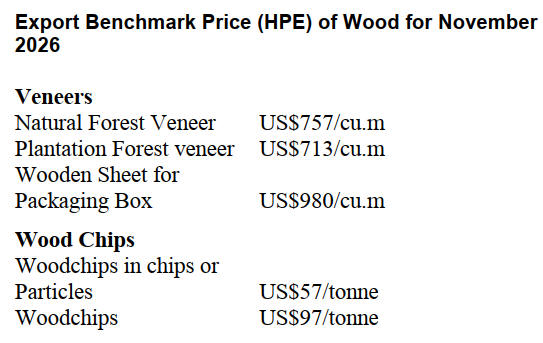
Processed Wood
Processed wood products which are leveled on all four
sides so that the surface becomes even and smooth with
the provisions of a cross-sectional area of 1,000 sq. mm to
4,000 sq.mm (ex 4407.11.00 to ex 4407.99.90)
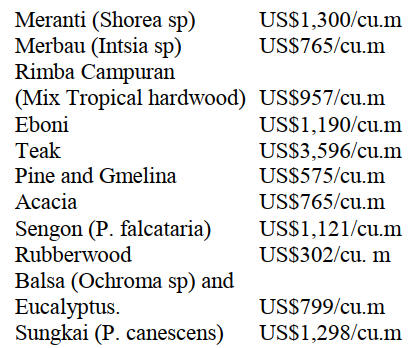
Processed wood products which are leveled on all four
sides so that the surface becomes even and smooth of
Merbau wood with the provisions of a cross-sectional area
of 4,000 sq.mm to 10,000 sq. mm (ex 4407.11.00 to ex
4407.99.90) = US$1,500/cu.m
See: https://jdih.kemendag.go.id/peraturan/keputusan-menteri-
perdagangan-republik-indonesia-nomor-2064-tahun-2026-
tentang-harga-patokan-ekspor-dan-harga-referensi-atas-produk-
pertanian-dan-kehutanan-yang-dikenakan-bea-keluar-dan-tarif-
layanan-badan-layanan-umum
Market expansion through export task force and
market intelligence
The Indonesian Furniture Industry and Craft Association
(HIMKI) is strengthening efforts to expand the global
reach for Indonesia’s furniture and handicraft products
through the establishment of an Export Task Force and the
development of furniture market intelligence in
collaboration with the Ministry of Trade.
HIMKI Chairman, Abdul Sobur, said the initiatives aim to
address industry challenges, including changing export
market dynamics, intensifying global competition, raw
material availability, productivity and product innovation.
The market intelligence initiative will help identify export
opportunities, track shifts in global demand and enable
industry players to develop more effective market
penetration strategies.
The export task force is expected to accelerate the
resolution of trade barriers and improve coordination
among industry players, the government and relevant
stakeholders. HIMKI is also promoting a Grand Strategy
for the furniture and handicraft industries to provide a
long-term framework for increasing production capacity,
strengthening supply chains, developing innovative
products and designs and expanding Indonesia’s presence
in international markets.
See:https://www.antaranews.com/berita/5822403/himki-pacu-
pasar-kerajinan-lewat-satgas-hingga-market-intelligence
Wildfires weigh on forestry and regional growth
According to Statistics Indonesia (BPS), Indonesia’s
forestry sector contracted 2.5% in the third quarter of
2026, a sharp reversal from 6% growth in the previous
quarter, as wildfires disrupted economic activities in
affected regions. BPS Deputy for Accounts and Statistical
Analysist, Mohd. Edy Mahmud, said the fires had
particularly affected provincial economies in Kalimantan,
contributing to slower regional economic growth.
However, he noted that the overall impact on national
economic growth remained relatively limited, although
several fire-affected provinces experienced some
economic constraints.
In related news, Indonesia and Singapore have agreed to
establish a joint task force to strengthen bilateral
cooperation in tackling forest and land fires and their
impacts, particularly by enforcing the law against
corporations proven to be responsible for causing the fires.
Indonesian Foreign Minister, Arrmanatha Nasir, said the
task force would serve as a platform for cross-border
information and financial intelligence sharing, evidence
gathering and investigations to strengthen corporate
accountability.
Both countries are committed to ensuring that companies
responsible for the fires face legal consequences while
also pursuing the long-term restoration of land and assets
damaged by the incidents.
The task force will also trace financial flows linked to
corporate involvement in the fires. Nasir welcomed
Singapore’s offer to share corporate data related to forest
fire cases, saying it would provide valuable support in
identifying perpetrators and strengthening enforcement
efforts.
See: https://en.antaranews.com/news/440639/indonesias-
wildfires-weigh-on-forestry-regional-growth-bps
and
https://money.kompas.com/read/2026/11/05/154900826/dampak-
karhutla-pertumbuhan-subsektor-kehutanan-berbalik-negatif-
pada-kuartal.
Evidence-based communication essential for effective
forestry sector policymaking
The Senior Advisor to the Forestry Minister, Bambang
Soepijanto, emphasised that evidence-based
communication and active public participation are
essential to effective forestry policymaking. He said
communication should be incorporated throughout the
policy process, from identifying issues and formulating
policies to implementation and evaluation, while providing
opportunities to gather public input and improve policy
outcomes.
Clear information that reflects conditions on the ground
can strengthen public trust, with communication success
measured by improvements in public understanding,
capacity and participation in forest protection. Speaking at
the Sustainability Communication Expert Dialogue and
the launch of the Center for Sustainability Communication
and Policy (CSCP) Indonesia, Bambang expressed hope
that the institution would bridge scientific knowledge,
policymaking and field experience to foster collaboration
among the government, academics, businesses, media, and
communities.
Indonesia’s FOLU Net Sink 2030 Advisory Board
member, Agus Justianto, stressed that achieving the
country's FOLU Net Sink 2030 target requires effective
communication strategies to ensure public understanding
and support for emission-reduction policies and
programmes in the forestry and land-use sectors.
He said, communication should not merely convey
government targets but also explain the benefits of the
initiatives and the public's role in achieving them.
See:https://www.antaranews.com/berita/5836423/komunikasi-
berbasis-bukti-jadi-kunci-keberhasilan-kebijakan-kehutanan
Partnership with Kangwon National University to
advance multi-business forestry
The Association of Indonesian Forest Concession Holders
(APHI) is exploring a partnership with Kangwon National
University (KNU) in South Korea to promote multi-
business forestry through landscape management.
APHI Deputy Chairwoman for Multi-Business Forestry,
Dian Novarina, explained that the approach integrates
timber, non-timber forest products (NTFPs) and ecosystem
services, including carbon projects to supply raw materials
for wood-based, food and energy industries while
supporting Indonesia’s Nationally Determined
Contribution (NDC) targets.
Dian emphasised that developing multi-business forestry
requires international cooperation and investment to
unlock the potential of high-value non-timber forest
products and generate high-quality, high-integrity carbon
credits.
See: https://forestinsights.id/dorong-multiusaha-kehutanan-aphi-
jajaki-kerjasama-dengan-kangwon-national-university/
Indonesia seeks to expand handicraft exports to
Canada
Indonesia’s Ministry of Trade is seeking to expand
handicraft exports to Canada, particularly baskets,
furniture and products made from natural fibers as they
have a strong potential in the Canadian market.
Director General of National Export Development,
Fajarini Puntodewi, encouraged Indonesian businesses to
strengthen their competitiveness and production capacity
while capitalising on opportunities in Canada. She also
urged exporters to take advantage of the Indonesia-Canada
Comprehensive Economic Partnership Agreement (I-CA
CEPA) which is scheduled to enter into force on
December 1, 2026.
Indonesia’s main exports to Canada currently include
machinery, electrical equipment, rubber products,
footwear, textiles and apparel, while its major imports
from Canada include wheat, fertilisers, wood pulp, mineral
fuels and other commodities.
See: https://en.antaranews.com/news/439799/indonesia-seeks-to-
expand-handicraft-exports-to-canada
5.
MYANMAR
6.
INDIA
Inflation tilts higher
India's headline retail inflation rose to 5.54% year-on-year
in September 2026, up from 4.83% in August, according
to data from the Ministry of Statistics and Program
Implementation. Rural inflation climbed to 6.08%,
outpacing urban inflation at 4.88%
See:
https://eaindustry.nic.in/press_release/press_release_202609.pdf
and
https://www.mospi.gov.in/themes/product/9-consumer-price-
index-cpi
Wood product price indices
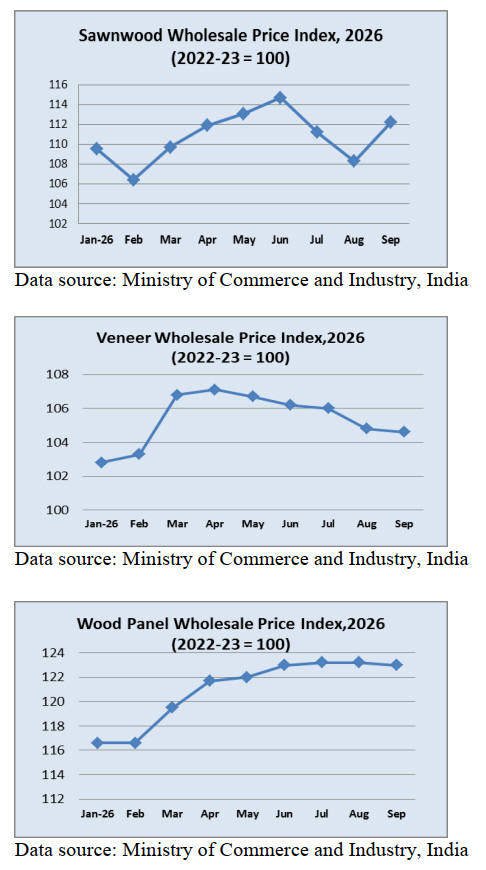
The Office of Economic Adviser (OEA), Department for
Promotion of Industry and Internal Trade (DPIIT) has
released the revised series of indices with a base Year
2022-23. The new series has replaced the previous series.
Please note the change in base year when examining
the
trends in the graphics below.
Plywood mills suffer flood damage
Recently, floods seriously impacted the wood panel,
plywood and furniture industries in Bihar. The Ganga and
Gandak rivers overflowed and inundated major industrial
hubs, manufacturing units and stock warehouses, stalling
supply chains across the region. This natural disaster has
affected the Indian plywood sector which is already
grappling with high raw material costs, BIS compliance
and tightened credit availability.
Ply Reporter specifically mentions the wood industries in
Patna, Hajipur, Mujaffarpur, Bhojpur, Saran, Vaishali,
Bhagalpur, Begusarai, Buxar, Samastipu, Munger, Katihar
Lakhisarai, Khagaria and Purnea. The government focus is
to see that every affected family gets flood relief and
reconstruction work is intended to build back better
infrastructure.
See: https://www.plyreporter.com/article/154393/flood-hit-bihar-
wreaks-havovc-for-small-wood-panel-industries
Restricted wood briquette exports
India is facing a severe Liquefied Petroleum Gas (LPG)
supply crisis driven by high import dependency and major
geopolitical disruptions in West Asia.
About 90% of India’s LPG imports travel through the
Strait of Hormuz, which faced severe security and
shipping disruptions following the regional conflict.
The government initially restricted or suspended
commercial and bulk LPG supplies to prioritise residential
kitchens and essential services like hospitals though
restrictions on non-domestic packed and bulk LPG were
partially eased as supply stabilised
In response to the LPG supply crisis, the Directorate
General of Foreign Trade (DGFT) shifted the export
policy for wood briquettes (ITC HS Code 44013200) from
"Free" to "Restricted" with immediate effect under
Notification No. 04/2026-27
See: https://www.deccanherald.com/india/centre-imposes-export-
ban-on-wood-briquettes-3958270
Australia an major source of logs
India imports around three-quarters of Australia's log
exports. According to UN COMTRADE data, India's
imports of "wood in the rough" (logs) from Australia in
early 2026 reached approximately US$183.82 million out
of US$184.08 million in total wood and wood article
imports from Australia. Softwood log exports to India
surged significantly as Australian exporters pivoted away
from China.
See: https://tradingeconomics.com/india/imports/australia/wood-
articles-wood-wood-charcoal
7.
VIETNAM
Wood and wood product (W&WP) trade
highlights
According to Viet Nam Customs W&WP exports in
October 2026 reached US$1.69 billion, up 13% compared
to September 2026 and up 10% compared to October
2025. WP exports alone, were valued at US$1.1 billion, up
13% compared to September 2026 and up 4% compared to
October 2025.
In the first 10 months of 2026, W&WP exports totalled
US$15 billion, up 7% over the same period in 2025 of
which WP exports are estimated at US$9.73 billion, up 1%
over the same period in 2025.
In September 2026, Viet Nam's imports of raw wood (log
and lumber) volumes at 588,000 cu.m, worth US$196.8
million, up 1% in volume but down 6% in value compared
to August 2026. Compared to September 2025 there was
an increase of 5% in volume and 14% in value.
In the first 9 months of 2026, imports of raw wood
reached 5.5 million cu.m, worth US$1.9 billion, up 7% in
volume and 17% in value over the same period in 2025.
Notably, the growth rate in value is significantly higher
than the growth in volume indicating that the average
import price increased reflecting the pressure on raw
material costs for the wood processing industry.
Viet Nam's NTFP exports in September 2026 were
recorded at US$79.10 million, down 9% compared to
August 2026 but up 19% compared to September 2025.
Although the total decreased compared to the previous
month the growth rate over the same period last year
shows that the NTFP exports maintained positive results.
In the first 9 months of 2026, NTFP exports contributed
US$742.56 million to export earnings, up 16% over the
same period in 2025.
In October 2026, exports of wooden furniture were
recorded at US$954 million, up 13% compared to
September 2026 and up 1% compared to October 2025. In
the first 10 months of 2026, exports of wooden furniture
totalled US$8.5 billion, down 0.2% over the same period
in 2025.
Upgrading Viet Nam’s acacia value chain
Viet Nam needs to turn the gains in acacia plantation
productivity into higher value per hectare and better
returns for forest growers. Longer rotations will require
finance, shared risk management and stronger links
between smallholders and processors.
Acacia has become a mainstay of Viet Nam’s export-
oriented wood industry. Between 2010 and 2025, its
plantation area expanded from about 880,000 hectares to
2.5 million hectares, while annual harvests rose from 2.4
million cu.m to approximately 17 million cu.m.
Productivity increased from 10–11 to 18–20 cu.m per
hectare per year and the use of improved planting material
rose from around 40% to 90%. Over the same period the
country’s wood and wood product exports increased from
US$3.44 billion to US$17.22 billion, supported by a raw-
material supply in which acacia plays a major role.
However, large-diameter logs account for only about 30%
of output. VIFOREST estimates that, across four principal
wood export product groups, woodchips and pellets
consume approximately 78% of the wood input, expressed
in roundwood equivalents but generate only 22% of export
earnings. Meanwhile, Viet Nam imported around 5.3
million cu.m of logs and sawnwood, worth US$1.76
billion in 2025.
The challenge is therefore broader than raising biological
productivity. It is to increase the value generated per
hectare and ensure that growers receive a fair share. This
requires a transition from biomass volume to usable timber
value, from poorly documented supply to verifiable origin
and from spot transactions to contractual relationships that
share benefits and risks.
Early harvesting makes financial sense
Harvest age strongly influences the products a plantation
can supply. Acacia harvested at four to five years is used
mainly for woodchips, pellets and thin veneer. Investment
in downstream processing alone cannot substantially
change this product mix without corresponding changes in
the timber grown and harvested.
For a smallholder, however, harvesting early can be a
rational decision. At an annually compounded interest rate
of 10%, a VND100 million loan grows to VND133.1
million in three years. Delaying harvest by three years
must therefore generate enough additional net revenue to
cover the extra financing cost, as well as the added
exposure to storms, pests and price fluctuations.
Woodchip buyers may offer to purchase an entire standing
crop in the fourth year and pay promptly. Buyers seeking
large-diameter timber may require trees to remain until
eight to ten years with no guaranteed future price.
Evidence cited for Quang Tri Province in 2024 indicates
that logs 15–20 cm in diameter fetched only about 18%
more than logs below 12 cm. Such a premium offers a
weak incentive to accept several additional years of risk.
Fragmented ownership compounds the problem. Around
half of the more than 1.54 million households using forest
land hold less than one hectare. Typhoon Yagi in 2024
demonstrated the vulnerability of plantation to livelihoods.
Intermediaries fill important gaps in this system. They
advance funds, aggregate small lots and assume price risk.
Upgrading the value chain should build on these functions
by involving them as partners in timber collection,
measurement and sorting. Any alternative arrangement
must provide growers with equally accessible services.
Information is another missing link. Downstream
requirements for dimensions, quality, certification and
traceability rarely reach growers as clear purchasing
specifications backed by differentiated prices. Repairing
this feedback mechanism could deliver substantial benefits
at relatively modest cost.
Four mutually reinforcing constraints
Finance and rotation length form the first constraint.
Limited access to credit and insurance encourages advance
sales and early harvesting. Short rotations produce small
timber and limit returns, leaving growers short of funds for
the next cycle. Advice to grow larger trees will have little
effect unless this financial cycle is addressed.
The second constraint concerns information and
bargaining power. Without public reference prices or
reliable estimates of standing timber volume, growers
negotiate from a weak position. Transparent prices and
accessible inventory services are among the most practical
early interventions.
The third is the cost of organisation and compliance.
Fragmented holdings make group certification, traceability
and access to higher-value markets difficult. The EUDR
makes this challenge more immediate. It is due to apply
from 30 December 2026 to large and medium-sized
operators and to micro and small operators already
covered by the EU Timber Regulation; other micro and
small operators have until 30 June 2027.
Supply chains must provide the relevant production-
location information and evidence that covered products
meet applicable legality and deforestation-free
requirements, including the 31 December 2020 cut-off
date.
Trade uncertainty adds to these pressures. The United
States, which accounted for about 55% of Viet Nam’s
wood and wood product export earnings in 2025,
introduced Section 232 tariffs of 25% on certain
upholstered wooden products, kitchen cabinets and
vanities in October 2025.
Under the announced schedule, these rates are set to rise to
30% and 50% on 1 January 2027, subject to applicable
exceptions or subsequent agreements. These developments
strengthen the case for market diversification and higher-
value products. Separately, Viet Nam’s VPA/FLEGT
framework with the EU and its forest and climate
commitments reinforce the need for legal, traceable and
sustainably managed supply.
The fourth constraint is biological risk. Poor control of
planting material, extensive use of a narrow range of
clones and repeated rotations can increase pest and disease
exposure and reduce site productivity. Reported findings
from local studies include wilt damage of 15–20% and
stem-borer damage of 15–25% in affected areas. These are
local findings rather than national incidence estimates.
Research findings also link complete removal of harvest
residues to the loss of approximately 61.5 tonnes of
organic matter per hectare and a cumulative reduction in
timber yield of about 130 cu.m per hectare over three
rotations. The implications depend on site conditions and
management but the direction is clear: soil fertility and
retained residues need greater attention.
Linking science with commercial demand
Viet Nam has recognised 155 acacia varieties across six
species, as well as four triploid varieties, with the Viet
Namese Academy of Forest Sciences playing a leading
role. Many have achieved yields of 20–26 cu.m per
hectare per year or more in trials. Research on wood
modification, laminated products and laminated veneer
lumber also indicates opportunities to expand acacia’s
uses.
Digital and certification systems provide a starting point
for better coordination. The iTwood system has issued
22,060 plantation identification codes covering 28,071
hectares, while the country’s total area under sustainable
forest management certification has reached
approximately 720,000 hectares. These figures refer to
different systems and coverage and should not be treated
as equivalent measures of acacia traceability.
The main gap is the connection between available
technology and commercial incentives. Tree improvement
still places considerable emphasis on growth.
Greater attention is needed to wood density, stem
straightness, heart rot, sawing and drying recovery and
resistance to wind and drought. Growers also need a clear
price reward for supplying the required quality, alongside
any certification premium.
A coordinated programme to 2035
Viet Namhas been advised to develop an integrated acacia
value-chain programme to 2035 with a vision to 2045. Its
core would be certified and traceable supply areas
producing large-diameter acacia timber, located where
storm risk is manageable and higher-value processing
capacity is accessible.
Southern Viet Nam merits early consideration as
approximately 700,000 hectares of acacia are located near
processing centres associated with nearly two-thirds of
national wood exporters.
Public investment could support trials, shared data and a
predictable regulatory framework. Enterprises could co-
invest and share the additional value created; research
institutions could respond to defined production needs and
provincial authorities could coordinate supply areas across
administrative boundaries.
Cooperatives and grower groups could provide the
organizational foundation. Sweden’s Södra, through which
tens of thousands of small forest owners jointly own
processing facilities, offers a useful example of how
growers can participate further along the chain.
Five areas require coordinated action, finance and risk
sharing, shared digital records, transparent prices and
contracts, better planting material and site management,
Higher-value processing and more value for growers and
industry.
Finance and risk sharing
Credit should match proposed rotations of eight to twelve
years and be combined with suitable insurance, including
carefully designed index-based pilots. Implementation of
Decree No. 58/2024/ND-CP should be translated into
accessible support for growers.
Options include credit secured against standing timber,
annual payments under forest-growing contracts and
jointly financed risk funds. Poor households cannot
reasonably bear the risks of the entire supply chain.
Outstanding value-added tax and refund difficulties
affecting wood businesses also need resolution.
International experience with annual forestry premiums,
including Ireland’s schemes, may offer lessons, subject to
local fiscal and institutional conditions.
Shared digital records
A digital record for each plantation plot should combine
geolocation, a plantation identification code and essential
management information.
Connecting these records with iTwood and enterprise
systems would support group certification, lending, supply
contracts and EUDR preparedness.
The aim should be coverage of the acacia resource of
roughly 2.5 million hectares, using common minimum
data standards and clear arrangements for updating
records. A digital record supports compliance; it does not,
by itself, establish compliance or certification.
Transparent prices and contracts
Regular publication of acacia prices by region and
diameter class would provide a reference for supply
agreements with processors. Standard contracts should
specify measurement responsibilities, grading procedures
and payment terms. Buyers’ requirements must translate
into understandable specifications and credible financial
incentives for growers.
Better planting material and site management
Breeding and deployment should combine growth with
wood quality and resilience. Priorities include thinning,
stand tending, integrated pest management and the
protection of soils and harvest residues.
Trials of improved microbial products could test the
proposed targets of raising productivity by at least 15%
and reducing mineral fertiliser use by 30%. These should
be treated as performance targets to validate under local
conditions.
Higher-value processing
Logs should be graded before cross-cutting so that suitable
timber reaches the most valuable use. Cooperative service
clusters could organise harvesting and primary conversion,
with a proposed target of reducing harvesting costs per
cubic metre by at least 15%.
Increasing processing recovery from 45% to more than
50% would yield over 11% more finished output from the
same wood input. Further opportunities include cross-
laminated timber and glued laminated timber, subject to
product testing and market requirements, alongside a shift
from contract manufacturing towards original design and
own-brand products.
More value for growers and industry
Progress should be measured by the annual yield of timber
meeting market specifications and by growers’ net
income, rather than plantation area or harvested tonnage
alone. Finance and risk sharing must make longer rotations
commercially feasible; grower organisation and technical
support can then help deliver the required timber.
Regional differences matter. Storm-prone areas need
particular attention to insurance, wind resilience and
appropriate rotation lengths. Areas with lower storm
exposure and good access to processors offer stronger
prospects for large-diameter timber.
Woodchips and pellets will remain important outlets for
small timber and processing residues. The task is to
improve the allocation of wood across competing uses
while enabling growers to capture more value.
Acacia has helped Viet Nam become a major wood-
processing and exporting country. Its next contribution
should be measured in stronger rural livelihoods, more
efficient use of each cubic metre and higher value from
every hectare.
See: https://nongnghiepmoitruong.vn/tri-thuc-nong-dan/nang-
tam-chuoi-gia-tri-keo-viet-nam-truoc-nguong-cua-moi-
d840465.html?fbclid=IwY2xjawVeufRleHRuA2FlbQIxMABwZ
G9mAWJyaWQRMXFTMTRjUTNFclZNVlhGNmtzcnRjBmFw
cF9pZBAyMjIwMzkxNzg4MjAwODkyAAEf-
AXZZIazFJ9IdEPJj506MNl1JzpsuV2hqgkX-B11jcGh2s-
1QQumvGl-ibI_aem_2SxSUEqR9pySwmiGVvf-Ew
and
https://nongnghiepmoitruong.vn/5-giai-phap-trong-chuoi-gia-tri-
cay-keo--nhin-tu-iufro-acacia-2026-d835504.html
8. BRAZIL
Engineered wood applications in the
construction
sector
At the 6th ‘Lignum Latin America’ held in Curitiba,
Paraná State, a Paraná-based company presented details of
a construction system based on Cross-Laminated Timber
an engineered wood panels. The system offers, says the
company, an alternative for expanding housing supply in
Brazil, which faces an estimated housing deficit of 5.9
million units.
The technology uses timber from planted forests,
including short and irregularly sized pieces that would
otherwise have been used for energy generation,
transforming them into structural panels for walls, floors
and roofs. Industrialised manufacturing enables more
efficient raw material utilisation, improved process control
and fewer construction stages on-site, adding value to the
forest-based production chain.
The system also has the potential to reduce carbon
emissions associated with the construction industry and
store CO₂ in building structures throughout their service
life.
See: https://apreflorestas.com.br/?noticias=construcao-em-
madeira-engenheirada-e-uma-das-alternativas-para-enfrentar-o-
deficit-habitacional-de-59-milhoes-de-moradias-no-pais
Improving the identification of Amazon timbers
The Center for Timber Producing and Exporting Industries
of the State of Mato Grosso (CIPEM), in partnership with
the Brazilian Institute of Environment and Renewable
Natural Resources (IBAMA), the Federal Rural University
of the Amazon (UFRA), the State University of Mato
Grosso (UNEMAT) and the Federal University of Mato
Grosso (UFMT) is coordinating a project aimed at training
specialists and establishing a reference collection of wood
samples to improve the identification of Amazonian
timber species.
The initiative seeks to reduce discrepancies in the
identification of timber species with similar anatomical
characteristics and common names, which may create
difficulties in licensing and trade, particularly in light of
the requirements of the Convention on International Trade
in Endangered Species of Wild Fauna and Flora (CITES)
for the harvesting and export of timber from ipê, cumaru
and cedar species.
The project also includes the development of technical
procedures for anatomical identification, validation criteria
and guidelines for specialists involved in issuing technical
reports.
The project will bring together the Mato Grosso State
Secretariat for Economic Development (SEDEC-MT), the
Federal Institute of Mato Grosso (IFMT), the Mato Grosso
Association of Forestry Engineers (AMEF) and Forest-
based Industry Business Trade Unions.
Currently in the institutional coordination phase, the
initiative includes defining the responsibilities of the
partners, organising the reference collection and planning
training programs and technical procedures, with activities
scheduled for 2027.
See: https://cipem.org.br/setor-de-base-florestal-articula-projeto-
para-identificar-especies-da-amazonia-e-dar-seguranca-as-
exportacoes-com-apoio-do-ibama/
Timber sector and transport agency discuss export
logistical bottleneckss
The Brazilian Association of Mechanically Processed
Timber Industries (ABIMCI) recently met with
representatives of the National Agency for Waterway
Transportation (Antaq), bringing together 120 participants
to discuss logistical bottlenecks affecting exports of
processed wood products.
The main challenges reported included vessel service
omissions, unilateral booking rollovers, lack of operational
slots at terminals, difficulties in returning containers and
rising international freight costs.
According to Antaq, processed wood products account for
approximately 63% of the Bills of Lading (BLs) involved
in complaints filed with the agency. Demurrage and
detention charges (detention for exports and demurrage for
imports) account for all reported claims with detention
predominating, representing 80% of occurrences.
During the meeting, Antaq presented its advances in the
inspection and regulation of container transportation,
highlighting the establishment of the Specialised
Container Inspection Group (GEF Contêineres) and the
Summary Preliminary Dispute Resolution Procedure,
introduced in 2025. This procedure allows direct
negotiations between users and service providers to
resolve issues related to container logistics.
As of October 2026, 302 reconciliations had been
successfully concluded resulting in the cancellation of
invoices totalling more than BRL27 million.
Another 139 concluded cases led to the cancellation of
US$315,000 and BRL538,000 in charges. Of the 811 cases
under review by GEF Contêineres, 556 are linked to the
dispute resolution procedure.
ABIMCI emphasised the importance of companies
actively filing formal complaints and submitting technical
evidence to Antaq as well as participating in the public
consultation process for the revision of Antaq Resolution
No. 62/2021 which regulates the rights and obligations
governing container logistics. The public consultation
aimed at improving the regulation remained open until
November 4, 2026.
See: https://abimci.com.br/setor-madeireiro-e-antaq-debatem-
gargalos-logisticos-e-avancos-regulatorios-na-exportacao-de-
conteineres/
The Netherlands announces contribution to the
Tropical Forest Fund
The Netherlands announced a US$500 million
contribution, to be disbursed over a 10-year period, to the
Tropical Forest Forever Facility (TFFF), a fund launched
by Brazil at the 30th United Nations Climate Change
Conference (COP30) to finance the conservation of
tropical forest. The commitment could contribute to the
protection of between 800 million and 900 million
hectares of forest.
Inspired by the sovereign wealth fund model, the TFFF
brings together governments of tropical countries and
private investors to raise and invest capital, with
investment returns allocated to tropical countries as an
incentive for forest conservation. The World Bank is
responsible for providing fiduciary and operational
support to the mechanism.
See: https://maisfloresta.com.br/fundo-florestal-do-brasil-ganha-
us-500-milhoes-da-holanda/
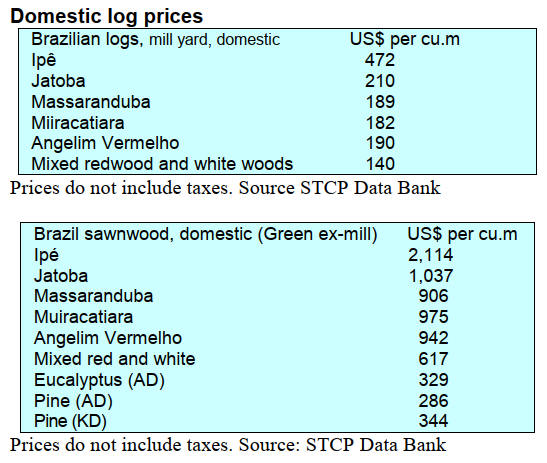
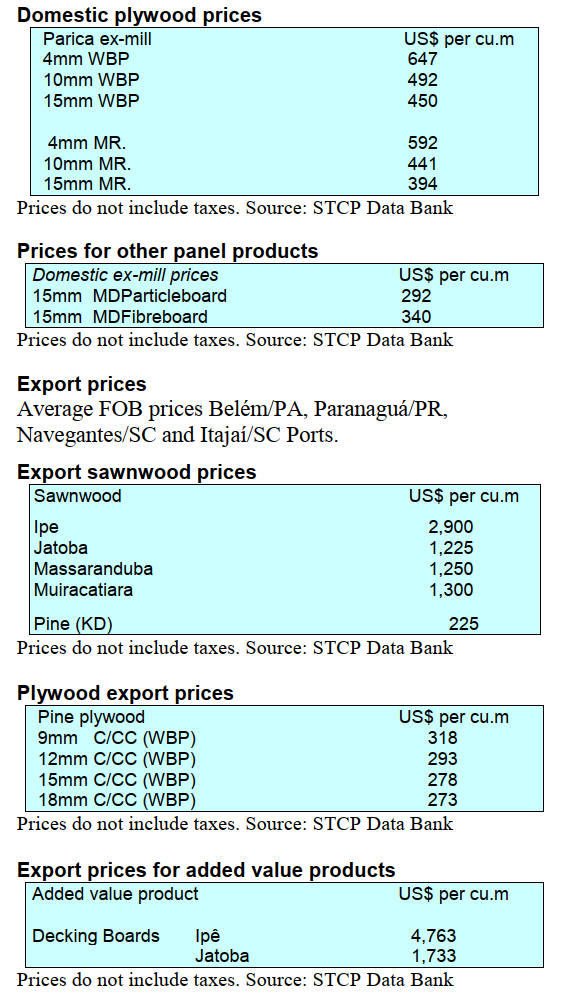
9. PERU
Exports of furniture and furniture
parts grew through
August
According to data from the Services and Extractive
Industries Division of ADEX, exports of furniture and
furniture parts reached US$2.9 million (FOB) between
January to August 2026, representing a 5.5% increase
compared to the same period in the previous year.
The United States was the leading destination for exports
in this subsector, accounting for 65% of the total and
recording a 12% increase compared to August 2025. Italy
ranked second, with a 13% share and a growth rate of
around 3%.
Bolivia held the third position with a 5% share. Puerto
Rico ranked fourth with 4% and Chile rounded out the top
five destinations, also accounting for 4% of exports.
Exports of veneered wood and plywood increased
According to information provided by the Services and
Extractive Industries Division of the Association of
Exporters (ADEX), exports of veneered wood and
plywood reached a value of US$2.4 million (FOB) in
August. This represents a positive change of 41%
compared to the same period in the previous year, when
the value was US$ 1.7 million.
Ecuador emerged as the primary export destination for
these products, accounting for a 46% share and a 104%
increase compared to the same period in 2025. Mexico
ranked second with a 31% share, showing a 1% increase
relative to the same period the previous year.
The United States held the third position with a 7% share.
The top five was rounded out by the Dominican Republic
and Colombia, with shares of 6% and 5%, respectively.
Directional felling limits tree damage
While timber harvesting creates opportunities for families
it must be carried out according to technical standards to
prevent forest damage. For this reason, "directional
felling" is promoted. This is a technique that allows for
controlling the direction in which trees fall thereby
reducing the impact on surrounding trees especially the
Brazil nut tree (Bertholletia excelsa).
In the Madre de Dios region, 62 authorised concessions
monitored between January and September 2026 have
been included on the OSINFOR Observatory’s "green
list." This recognition was earned because the concession
holders implemented management and silvicultural
practices that promote responsible timber harvesting, such
as directional felling.
In these instances the technique helped protect 74,033
hectares of forest. Its application is particularly important
in Brazil nut concessions where timber is also harvested as
it allows for the planning of tree felling, helps reduce
damage to the surrounding vegetation and protects Brazil
nut trees and other species whose fruits and products serve
as a source of income for the families who utilise these
resources.
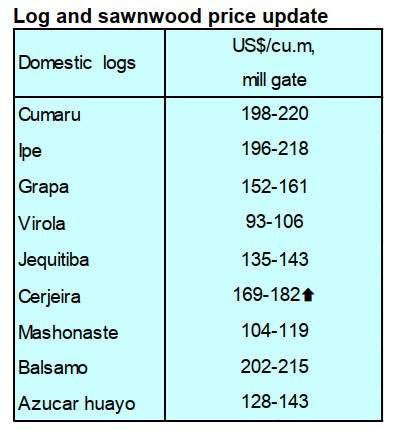
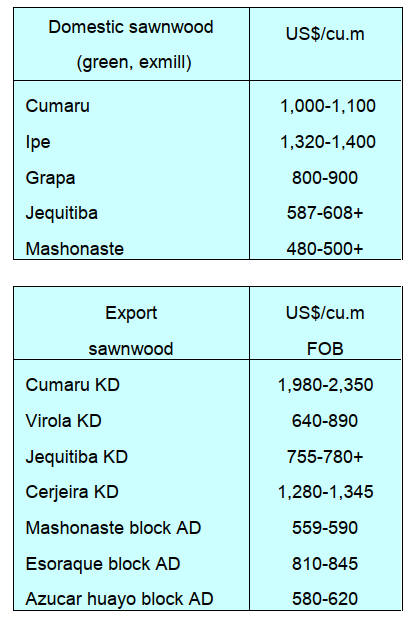 |