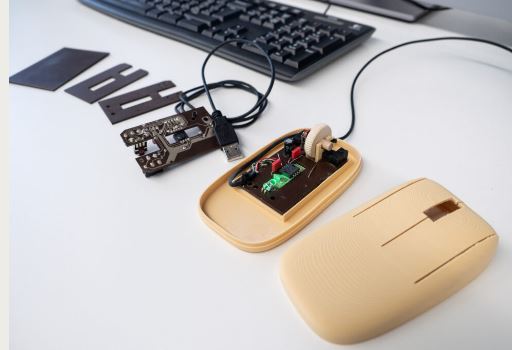
The biodegradable mouse works like any other computer mouse –
the 3D-printed casing was made from a mixture of biodegradable
plastic and wood fibers. Photo: Empa
Swiss researchers have developed a biodegradable version of
printed circuit boards—an important step toward sustainable
electronics.
Printed circuit boards are the heart of every electronic device:
they are covered with copper tracks and soldered electronic
components, usually painted in a characteristic green color, and
are made from fossil raw materials.
The Swiss Federal Laboratories for Materials Science and
Technology (Empa) is working on a sustainable variant—but
the “green” alternative is actually brown and based on wood.
WASTE PRODUCT
The raw material for the substrate is a natural mixture of
cellulose with some lignin, strictly speaking a waste product
for which there has been no use to date. In order for the flaky
lignocellulose to be turned into a high-tech product such as a
printed circuit board, it must first be ground with the addition
of water to break down the relatively thick cellulose fibers
into fine cellulose fibrils. This creates a fine network of
wafer-thin fibrils that are interconnected. In the next step,
the water is pressed out of the mass under high pressure, the
fibrils move closer together and dry to form a solid mass.
SENSITIVE TO MOISTURE
The resulting board is almost as resistant as a conventional
printed circuit board made of glass fibers and epoxy. Almost –
because the compostable board is still sensitive to water and
high humidity, according to Empa. However, water is necessary to
ensure biodegradability. The researchers are confident that the
resistance of the lignocellulose biocomposite can be further
improved with the right processing.
COMPOSTABLE COMPUTER MOUSE
The sustainable circuit boards are printed with conductor tracks
and fitted with components to produce functioning electronic
devices, such as a computer mouse or an RFID card. At the end of
its service life, such a device could be composted under the
right conditions – once the carrier material has decomposed, the
metallic and electronic components can be removed from the
compost and recycled, according to Empa. Work is now underway to
make the biomaterial for circuit boards more resistant without
compromising its biodegradability. Further demonstration devices
with lignocellulose boards are also planned.
Source:
holzmagazin.com


